
A Far Side Special Edition
Happy New Year one and all!

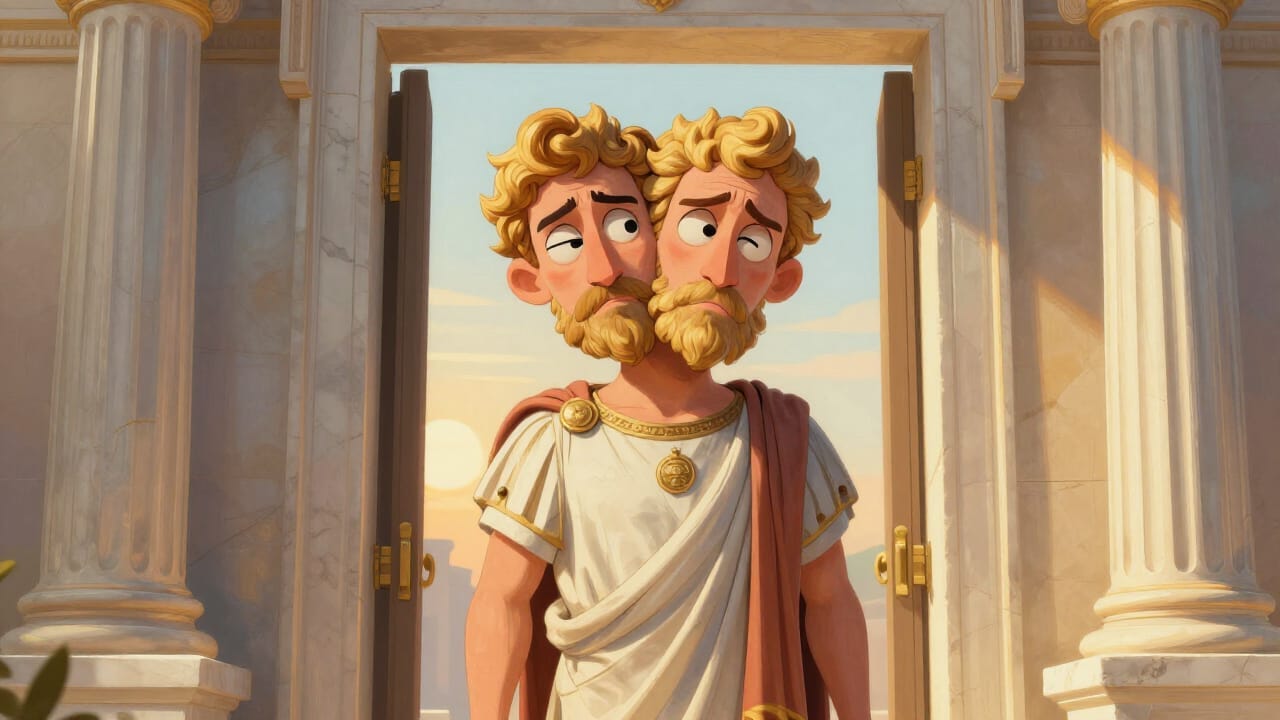
Ah, Janus. The Roman (always the Romans) god who refuses to die. Eternally standing on the threshold looking forward and backward at the same time. He wasn’t meant to start the year, but the symbolism worked out pretty darned good…for him, anyway.
You may have wondered (or maybe not) why January 1st is New Year’s Day. There’s no change of seasons, no major cultural events, no significant astrological alignments, no harvests to celebrate, and in fact it’s the dead of winter in the northern hemisphere. So who in the hell stuck a major holiday like this in a completely meaningless and annoying position?
After all, the Romans (always the Romans) started their year in March, which is why we have seventh, eighth, nineth, and tenth months (septem, octem, novem, decem) out of sequence, and the US President used to start his term in March.
Well, it all goes back to 153 BC, and the Roman (always the Romans) election of consuls. A consul was the highest elected political office under the Republic — effectively a co-executive and military commander. Each region or territory had two of them, one civil/judicial and one military, as co-equal executives. The consuls took office in March at the beginning of the year, for a one-year term.
Until the war in Spain.
The Roman Senate (always the Romans) changed the inauguration date and seated the consuls on 1 January of that year out of political and military expediency, due to the war. One hundred and seven years later, Julius Caesar reformed the calendar, making it Sun-based, and locked in January 1st as the beginning of the civil year.
After the Roman (always the Romans) Empire collapsed, and the Vatican effectively took over, the Julian calendar was maintained as the church calendar, but it had flaws. Easter (a moveable feast) was slipping out of its March-April time slot, because the solar year refused to be exactly 365 sidereal days long, and the leap year every four years didn’t account for all the discrepancies.
In AD 1582, Pope Gregory XIII took on the task of fixing the calendar to keep Easter in spring. He instituted the formula of making leap years divisible by 4, unless they were also divisible by 100, except when they were divisible by 400. This change also locked in January 1st as the beginning of the church calendar, for no other reason than that’s the way it had been since the Roman (always the Romans) republic.
The new calendar wasn’t universal. Britain and the colonies didn’t adopt the Gregorian calendar until AD 1752, and Russia only after the Bolsheviks took control — though the Orthodox church still uses the Julian calendar and won’t celebrate its new year until January 14th.
Here in Indonesia, January 1st is just the first of five new year holidays — there’s the Muslim (Hijiri), Buddhist (Mahāyāna), Hindu (Saka), Lunar (Chinese), and Balinese holidays to look forward to. January 1st is the official civil new year, but there’s still some serious parties and fireworks coming up.
We still have one lunar month in our year: February, which is 28 days long, like a lunar “day”. Being the last month of the old Roman (always the Romans) year, it was the month of purification rituals, known as Februa. After purification, the citizenry were in the proper state of mind to cast ballots for the consuls.
Your bonus factoid du jour: Janus is the Roman (always the Romans) god of beginnings, transitions, and duality — a uniquely Roman deity with no direct Greek equivalent. He is depicted with two faces, one looking forward and one backward, representing past and future, entrance and exit, war and peace, or change and continuity. He governed doorways, gates, thresholds, and time itself, especially moments of transition such as the start of the day, month, or year. He was not a warrior or trickster, but a calm, watchful guardian of transitions — symbolizing balance, reflection, and renewal.
Perhaps a small sacrifice to Janus might be in order for 2026? Just sayin’.
=====
For this special edition of Far Side, I am recommending not just a movie, but an entire series: I, Claudius (1976). This is the finest 13 hours of TeeVee you will ever see, with some of the greatest actors of their time. It’s an adaptation of Robert Graves’ series of novels, which I find rather dense, but the dramatization is brilliant in every way. Look for the unexpurgated version, which has a spicier Caligula (John Hurt), and check out a young Patrick Stewart as Sejanus. Brian Blessed as Augustus is absolutely amazing. Siân Phillips as Livia nearly steals the show. Derek Jacobi as Claudius is artistry in motion. Notice the subtle differences in character as he ages. Stunning performance.
Faustum annum novum! from the Far Side:
E-book: Paper Golem: Corporate Personhood & the Legal Fiction
Contact Bernard Grover: bernard (at) radiofarside (dot) com
Radio Far Side, published (mostly) every Sun/Wed at 7a CST/7p WIB, is a labour of love. We don’t use a paywall, and we don’t sell stuff. We just create things to inform and entertain. But like any good busker on the digital mean streets, we put our hat down and if you feel inspired, drop a coin in to show your appreciation:
BTC wallet: bc1qth6drgzcyt7vlxxpvqh6erjm0lmaemwsvf0272
XRP wallet: rMSQzLyE3RHacCLwYPADBbq4RHQ71HpCzw

I'm going to save this post to explain to people why I go to bed at 10pm every Dec 31st. I can't help but wonder what the world would be like without any calendar model - just day and night and seasons.
Just can't escape those pesky Roman's.