
Did You Myth Me?
Assuming the question, or questioning the assumption?

If I handed you a piece of parchment and said it was from Leonardo da Vinci’s diary, would you believe me? If you tested it and the parchment and ink dated correctly, and handwriting analysis said it was consistent with da Vinci’s other “known” writing, would you believe that? Think of all the assumptions that are involved in this simple example:
Did Da Vinci actually exist? Did he keep a diary? Just because a pile of parchment has similar handwriting, does that prove it was written by someone called da Vinci? What are all the assumptions underlying the dating processes? We don’t even know if the remains in the grave marked “Da Vinci” are actually his. Look it up.
I beg the dear reader’s indulgence. I have to build a framework for today’s thesis that requires some background information on the Great Year and a broad outlook on the developmental history of human civilization.
The Great Year is composed of 12 Great Months, which mark the precession of the March equinox through the zodiac. The equinox moves roughly one degree counterclockwise every 72 years, for a total length of around 25,000 to 27,000 years, depending on who you ask.
The Great Year mythos does not necessarily cause or predict history; rather, it provides an ancient symbolic grammar through which human cultures have repeatedly organized, remembered, and interpreted civilizational development.
Even today, our generally accepted “scientific” story about our history seems to closely follow the symbolic themes of the Great Year:
Leo: divine kingship = the Golden Age (10,900 BC)
Cancer: birth and enclosure = the decline to a primitive state (8700 BC)
Gemini: language and polarity = development of clans, tribes, cultures (6640 BC)
Taurus: fertility and agriculture = farming and domestication of animals (4400 BC)
Aries: sacrifice and conquest = the great ancient empires (2200 BC)
Pisces: faith and salvation = collectivism and global civilization (0)
Aquarius: knowledge and systems = the New Golden Age (incoming AD 2150)
So, if we apply our generally-accepted Western narradigm to the rough dates for the Ages, we have the mythical Golden Age of the Atlantian Period in Leo, the Noahide flood in Cancer, Eden and differentiation into the sexes in Gemini, early civilization in Taurus, the great empires in Aries, Christendom in Pisces, and a New Golden Age or Sci-Fi World in Aquarius.
We have Bauvall, Gilbert and Hancock placing the creation of the Sphynx and Great Pyramid in Leo, based on stellar alignments. We have West and Schock giving similar dates based on erosion patterns. Depending on who you listen to, Plato placed Atlantis about 11,000 years ago, or near the same timeframe as the ‘alternative’ Sphynx/Pyramid dates.
We have the Old Testament telling the story of people creating a Golden Calf and Moses destroying it in the Age of Taurus. We have the Lamb of God being sacrificed in Aries. We have salvation theology and a guy wearing a fish head in Pisces. And we have Jesus telling his disciples to find a man carrying a jar of water to prepare for a future event. Then we have clif high telling us Sci-Fi World (the New Golden Age) begins with Aquarius.
If we view this in the same way as we might assume that our Big Bang myth is just Thomas Aquinas’ creatio ab nihilo retold for a “modern audience,” then we can argue that our modern historical narradigm about human origins and development is just a retelling of our ancient myths with modern terminology and sensibilities.
Is it possible that the repeating theme of a wise leader, a dying/resurrecting god, and 12 tribes/disciples are just narrative tools to teach basic astronomy (Ophichus and the Zodiac—great band name)?
The purpose here is not to ask whether astrology has any validity, but whether we have developed our civilization’s narrative to fit astrology. It seems to me that we have collectively massaged our sciences to align with our religions and superstitions, rather than starting from First Principles and building outward on observation and experimentation.
The reason I bring all this up is to ask this: is the Disclosure/UFO/UAP narradigm a carefully managed effort to update old mythology with modern terminology?
The efforts of folks like Graham Hancock, Paul Wallis and Mauro Biglino to reframe ancient texts in the light of “paleocontact,” as Wallis calls it, appear to be rewriting our “divine” stories as “ET” stories; in other words, putting ancient mythology in modern vocabulary. They all use the same underlying assumptions.
Don’t get me wrong. I very much enjoy Hancock, Wallis, Biglino, et al. I find their ideas and postulates intriguing and worthy of investigation, but I have to check the fundamental assumptions at the same time. A common assumption among all of them is that the ancient texts aren’t completely fabricated ghost stories.
Is Disclosure a retelling of the Second Coming? Are UFOs our modern version of angels and demons? Is Universal Consciousness an updated god for modern audiences?
Here’s the deal: it looks to me as if all religions are based on the same fundamental mythos, edited and updated to suit whatever needs the contemporary audience has. In Jungian terms, humans have a core set of archetypal symbols and stories that we continuously update to match our current social and conceptual frameworks.
With this in mind, isn’t Scientism just the latest iteration of our collective vision of ourselves and who we think we are? Aliens manipulating our DNA to create a slave race is essentially the Old Testament narradigm of creation with a fresh lexicon. The ancient axiom of “as above, so below” is being polished and restored with a few modern touches to make it more “relevant” to modern audiences.
“As above, so below” itself comes from the Emerald Tablet — Tabula Smaragdina — a short Hermetic/alchemical text attributed to the legendary Hermes Trismegistus, the syncretic Greco-Egyptian figure combining Hermes and Thoth. Hermes and Thoth are themselves updated versions of…well, you get the idea.
In the end, we are just telling the same old ghost stories with the jump-scares in different places and an updated twist at the end to keep them fresh. Everything we think we know about ourselves shares the same basic set of assumptions with a constantly rotating set of interpretations. Our mythology is the command and control system playing dress-up in the costume shop.
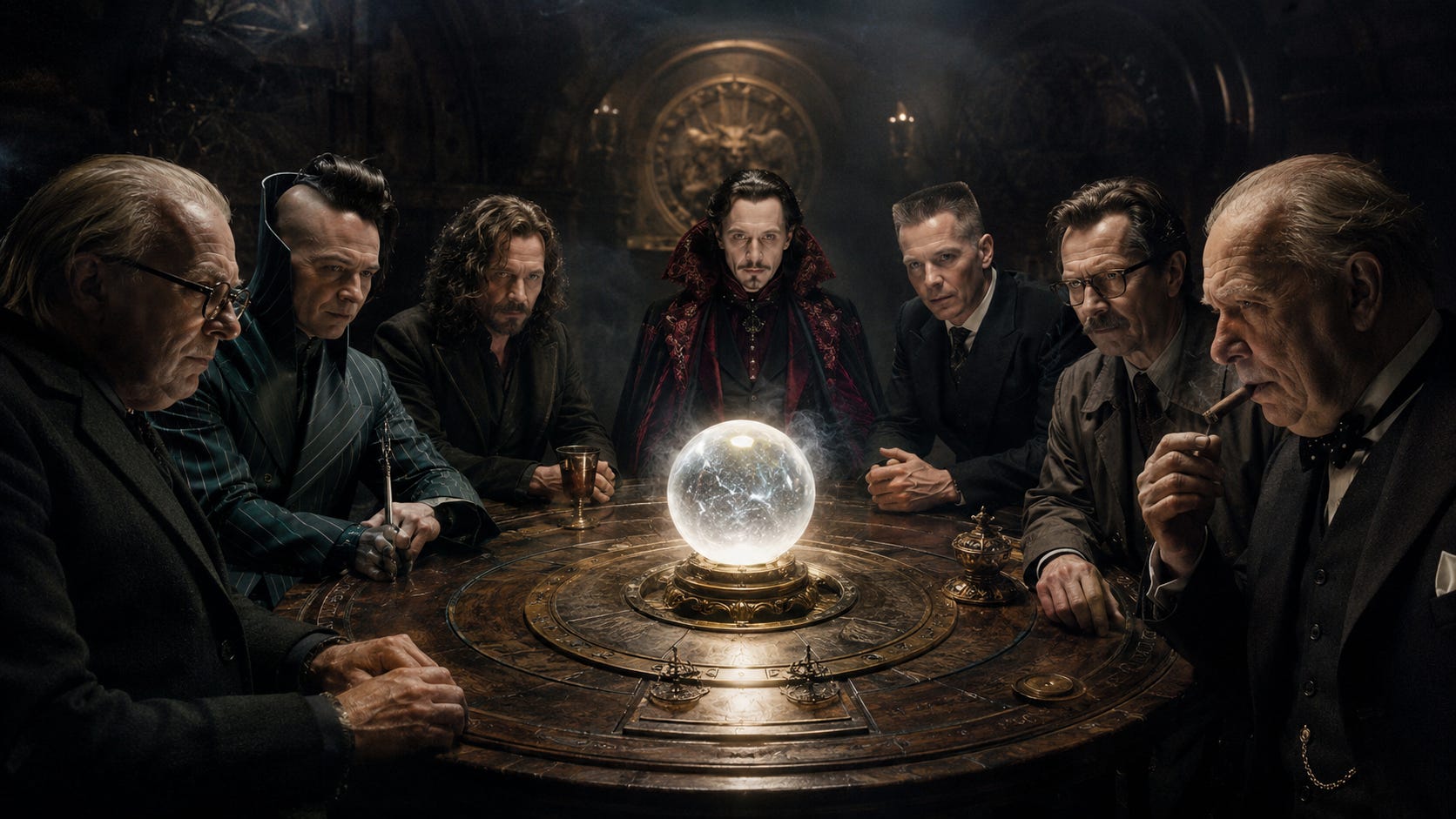
Gary Oldman looks and acts differently in every role, but fundamentally he’s still Gary Oldman.
Si mundus vult dicipi, ergo dicipitatur.
=====
For today’s cinematic mythology, I’m going with a rare triple feature that together cover all the themes in today’s screed, plus Gary Oldman in some of his most iconic roles. First, Bram Stoker’s Dracula (1992), followed by The Fifth Element (1997), and wrapped up with Tinker Tailor Soldier Spy (2011). Not only are these all great films featuring one of the best actors of our time, but they highlight mythmaking, religion, and command-and-control systems in creative and entertaining stories. Sugeng mirsani!
Weaving myths on the Far Side:
Home Site / Old Blogger Site / LinkedIn / Farcebook / IMdB
E-book: Paper Golem: Corporate Personhood & the Legal Fiction
Contact Bernard Grover: bernard (at) radiofarside (dot) com
Radio Far Side, published (mostly) every Sun/Wed at 7a CST/7p WIB, is a labour of love. We don’t use a paywall, and we don’t sell stuff. We just create things to inform and entertain. Like any good busker on the digital mean streets, we put our hat down and if you feel inspired, drop a coin in to show your appreciation:
BTC wallet: bc1qth6drgzcyt7vlxxpvqh6erjm0lmaemwsvf0272
XRP wallet: rMSQzLyE3RHacCLwYPADBbq4RHQ71HpCzw

Polymathish, Wisdom Teacher; it appears we share many. If there’s a bigger picture, you ‘ll find cause your looking in all the right places. I read a Taoist’s essay preceding which spoke to a philosophical vision on a parallel path; Stoicism places life in a larger orbit, Taoism in the largest movement. Hope you’re safe in your abode, read about some momentous earth shaking in your neighborhood.
"The more I know, the less I understand." - Don Henley