
PNAC
Protocols for a New Authoritarian Civilization

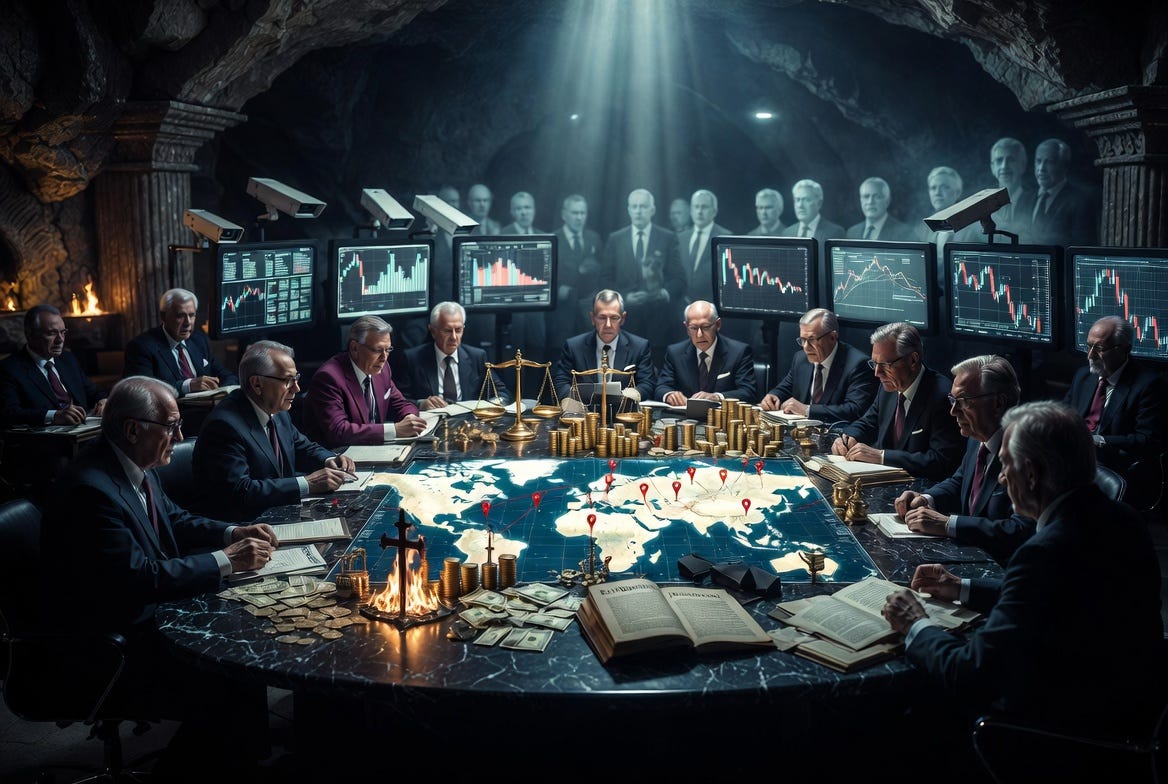
One of the greatest satirical pieces ever written is Jonathan Swift’s 1729 essay, A Modest Proposal. It is a savage attack on British policy toward impoverished Ireland. Adopting the cool, numerical tone of an economic planner, Swift proposes that poor Irish families sell their infants as food to the wealthy.
The Protocols of the Learned Elders of Zion are presented as a transcript of one or several meetings of a planning committee seeking to dominate Europe and the United States in the late 19th and early 20th centuries. The document’s provenance is obscure, and its language explicitly implicates an ethno-religious group that would appeal to the apocalyptic Christian mind-set.
On this last point, I suspect this is a deliberate attempt to deflect criticism and obfuscate the source for reasons that should become apparent.
The Protocols are said to draw heavily upon Maurice Joly’s Dialogue in Hell Between Machiavelli and Montesquieu, an anonymous political satire published in Brussels in 1864, and smuggled into France.
Written as an imaginary debate between the two dead philosophers, Joly’s work attacked Napoleon III by having “Machiavelli” explain how a modern ruler could hollow out constitutional government, manipulate the press and public opinion, control finance and commerce, and preserve the appearance of liberty, while constructing an authoritarian state.
Decades later, passages from Joly’s satire were extensively adapted and recast as the deliberations of a secret governing council. Pavel Krushevan’s Znamya serialized a version in 1903. Sergei Nilus published the complete text in 1905, as the concluding section of his religious-political book, The Great within the Small and the Antichrist, presenting it as evidence of an organized program for global domination.
It is worth noting that the Protocols first appeared in a Russian newspaper in 1903, with Nilus publishing the fuller text in 1905, amid the revolutionary and anti-tsarist currents that culminated in the Revolution of 1905, and, twelve years later, the Bolshevik seizure of power. The document may therefore be read, at least in part, as a reaction to the political upheavals already gathering force in late-imperial Russia.
The Protocols’ incendiary language and apocalyptic framing appear calculated to provoke fear and give that fear a recognizable object. To readers steeped in Protestant end-times theology, the document could readily be interpreted as a blueprint for preparing the political and social conditions under which the Antichrist might arise and assume power.
However, if we strip away the “Zionist” language and restore Joly’s critique of Napoleon III as the context, the text reads as a strategy for political domination couched in satirical language that may also have afforded its author plausible deniability.
The Protocols can be read as a systematic blueprint for advancing globalism. Stripped of its polemical framing, its central thesis brings into focus many of the methods employed over the past century to weaken established institutions and replace them with more centralized forms of political and economic control..
The Protocols’ principal tenets may be summarized as:
Replace moral politics with power politics. Exploit selfishness, use force and deception, and treat political rights as instruments rather than principles.
Control governments through finance. Create economic dependency, manipulate markets and public debt, and use financial crises to weaken independent states.
Produce social conflict. Encourage class warfare, strikes, unrest and political extremism until existing governments appear incapable of maintaining order.
Undermine religion and traditional authority. Promote materialism, scepticism and secular ideologies so that inherited moral restraints lose their influence.
Centralise administration. Expand bureaucracy, restrict independent institutions and gradually concentrate decision-making in a hidden directing authority.
Monopolize land, industry and commerce. Encourage speculation, rising costs and economic concentration so that small proprietors become dependent upon large financial systems.
Manipulate international conflict. Engineer rivalries and wars, keep nations mutually suspicious and intervene as financiers, mediators, or supposed peacemakers.
Prepare a replacement government. Recruit technically competent but politically controllable administrators to take office when the old system collapses.
Re-educate society. Reshape public thought through schools, universities, political theory and controlled intellectual fashions.
Capture representative institutions. Manipulate elections, constitutions and political parties, while making elected officials dependent upon concealed interests.
Convert constitutional government into dictatorship. Preserve democratic forms temporarily, while transferring actual authority to an increasingly absolute executive.
Control the press and information. Own, finance, censor, or intimidate newspapers; manufacture controversy; overwhelm the public with contradictory information; and marginalize independent publications.
Distract the population. Use entertainment, spectacle, sport, scandal, and trivial controversy to prevent sustained attention to political manipulation.
Destroy rival belief systems. Discredit established religion and philosophy, then substitute a new universal ideology centered upon the coming regime.
Suppress organized opposition. Penetrate secret societies and political organizations, identify opponents and neutralize them through surveillance, disgrace, exile or force.
Control education and historical memory. Replace independent thought with memorisation, vocational narrowness and officially approved interpretations of history and politics.
Subordinate law and the professions. Control lawyers, judges, clergy and other independent professional classes; reduce courts to instruments of administration.
Organize surveillance and political policing. Establish intelligence networks, informants and preventive detention to detect resistance before it becomes effective.
Criminalize political dissent. Treat opposition to the regime as sedition, remove procedural protections and ensure that political cases are decided in the government’s interest.
Reconstruct public finance. Impose centralized taxation, detailed accounting and state control of expenditure, while eliminating fiscal independence outside the central authority.
Use debt to dominate states. Encourage government borrowing, compound interest and refinancing until national revenues are consumed by debt service.
Accumulate and control gold. Concentrate monetary reserves, manipulate currency and credit, and use possession of hard assets as the foundation of political supremacy.
Secure obedience through paternal rule. Provide employment, regulate consumption, discourage idleness and present authoritarian government as protection against disorder and poverty.
Install and preserve the supreme ruler. Select a disciplined, apparently virtuous monarch-like leader; conceal weakness or incapacity; train successors; and maintain the regime through secrecy, centralization and carefully managed public loyalty.
As I read these, I can imagine the agenda of any Davos confab. I can hear Larry Fink, George Soros, or Klaus Schwab expounding on the virtues of these points. I can imagine the CIA plotting its next color revolution. I can visualize the Deep Staters ticking off their achievements. I can even hear Machiavelli and Montesquieu debating the efficacy of this strategy.
Like Swift’s essay, the Protocols may reveal a harder proposition once their rhetorical framing is removed. Read apart from Joly’s imagined dialogue and Nilus’ religious and racial context, the text presents a recognizable strategy for dismantling existing institutions and replacing them with a new political order. Its methods are not merely theoretical. Parallels can be found throughout modern political and economic life. The essential claim is stark: civilisation is not simply decaying of its own accord, but is being systematically weakened to prepare the ground for something intended to replace it.
To establish an entirely new order, the existing one must first be weakened, public understanding clouded, and social and political conflict intensified—all while the resulting upheaval is presented as an organic, grassroots movement for change.
And that, dear reader, is an entirely different essay.
Si mundus vult dicipi, ergo dicipitatur.
=====
For today’s companion film, Network (1976) and They Live (1988) come immediately to mind, but I’ve recommended them in the past for similar themes. So for this instance, I’m going with Z (1969), directed by Costa-Gravis. This brilliant French-Algerian film dramatizes the 1963 assassination of Greek politician Grigoris Lambrakis, and the subsequent cover-up. It highlights many of the points in today’s essay, while doing so with masterful tension and story-telling.
Command and control on the Far Side:
Home Site / Old Blogger Site / LinkedIn / Farcebook / IMdB
E-book: Paper Golem: Corporate Personhood & the Legal Fiction
Contact Bernard Grover: bernard (at) radiofarside (dot) com
Radio Far Side, published (mostly) every Sun/Wed at 7a CST/7p WIB, is a labour of love. We don’t use a paywall, and we don’t sell stuff. We just create things to inform and entertain. Like any good busker on the digital mean streets, we put our hat down and if you feel inspired, drop a coin in to show your appreciation:
BTC wallet: bc1qth6drgzcyt7vlxxpvqh6erjm0lmaemwsvf0272
XRP wallet: rMSQzLyE3RHacCLwYPADBbq4RHQ71HpCzw

A masterful piece about the protocols, thank you! Stripped of ethnic & religious description, the 24 parts are a perfect description of what's happened to the world. Absolutely perfect!
From your chronology and what we now know about the British involvement in the rise of the Bolsheviks, it sure looks like the same folks Swift was shaming were probably the ones responsible for the Protocols. For that matter, your list fits the neo-imperialist British project very closely. See Richard Poe's How the British Invented Globalism.