

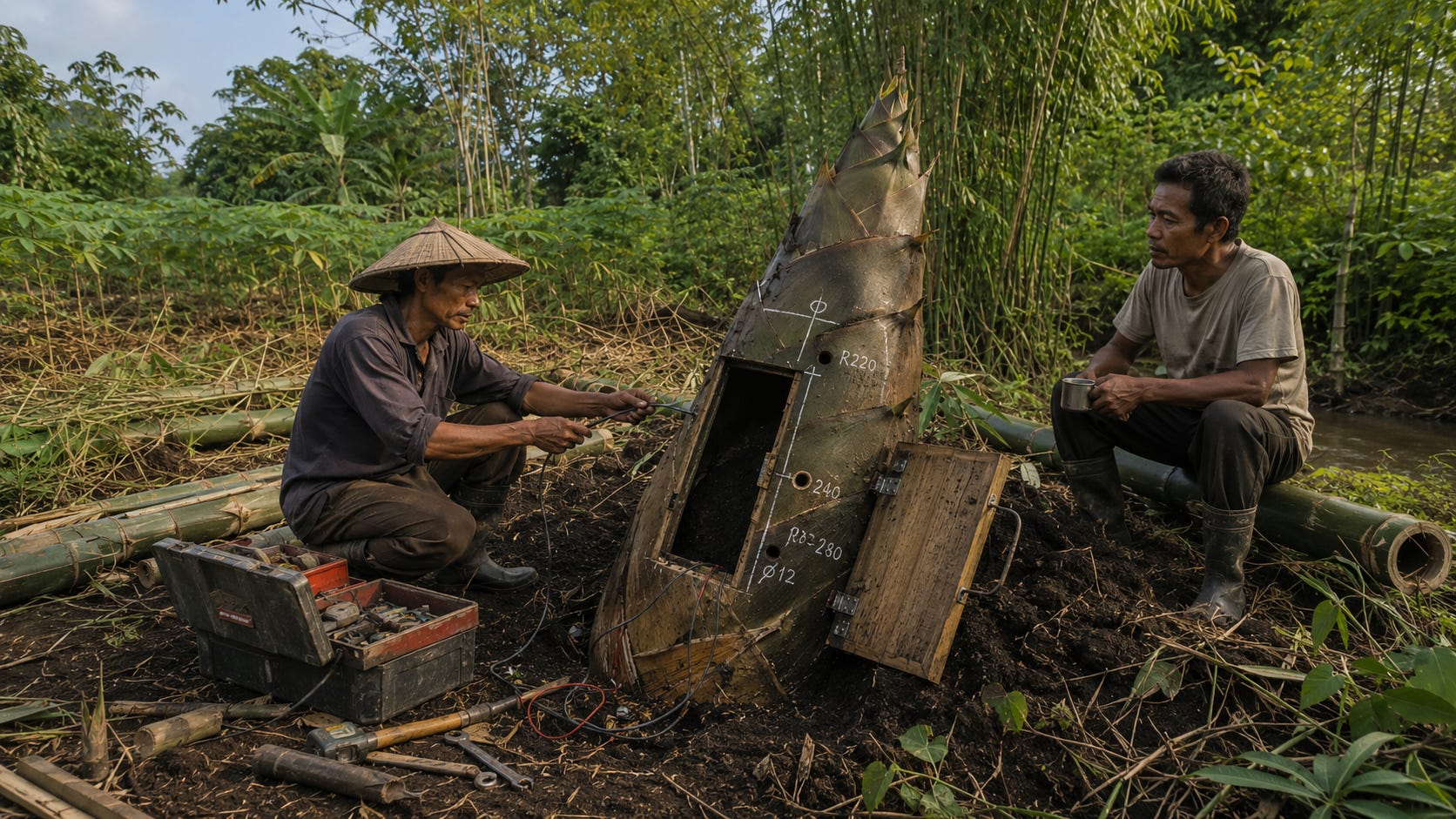
Sulang set the toolbox beside the bamboo. The toolbox itself was a single node of a large bamboo, aged and worn to a deep bronze color. There was a section cut and hinged to form a lid and an old leather strap attached at either end. He opened it.
The contents were not impressive. Two hammers, three screwdrivers, a pair of pliers, several spanners, a hand drill, a hacksaw blade with one end wrapped in newspaper and tape, a half-melted roll of electrical tape, some chalk, string coiled on a stick, assorted rusty bolts, and a number of objects that had ceased having identifiable purposes years ago.
Sulang believed a man who threw away old hardware lacked imagination, as much as he lacked the hardware.
He took out the chalk. For most of the morning he did nothing that could reasonably be described as construction. He measured and marked with the chalk.
He measured the bamboo from the ground to the tip, then measured it again, because the first number seemed unlikely. He measured the circumference in four places. He tied a stone to a length of string and used it to establish something approaching vertical. Then he stood back, frowned, swatted some mosquitoes, erased several chalk marks and started over.
The bamboo endured all this patiently and silently.
By eleven, Sulang had drawn a large rectangle on one side of it. He looked at the rectangle for some time. Then he picked up the saw.
Cutting green bamboo was normally easy. Cutting this bamboo was like watching Lela negotiate the price of bananas at the market.
The outer skin resisted the first strokes with an unpleasant squeal. Beneath it, the wall was thick, dense and wet. Sulang worked slowly, stopping every few minutes to wipe sweat from his eyes and adjust his grip on the saw blade.
At lunchtime he had completed only two sides. Lela came looking for him carrying rice, fried tempeh and a bottle of water. She stopped beside the clearing to appraise Sulang’s progress.
“What are you making, sayang?” Her voice carried both concern and resignation.
“I have started,” he replied cryptically.
“I can see that,” she said, exasperated. “But will it buy rice for the table?”
Sulang sat in the shade and opened the food. Lela looked at the chalk rectangle.
“Started what?”
Sulang considered the question while chewing. The sambal made his eyes water, just the way he liked it.
“The opening,” he said, deep in thought. “I need to get inside.”
Lela waited. Years of marriage had taught her that sometimes information arrived one piece at a time, sometimes it arrived all at once, and sometimes it never arrived at all. In any case, it was best to let it take its time.
“Of course,” she said. She went home.
By late afternoon, Sulang had cut all four sides. He wedged the hoe blade into one edge and pulled. Nothing happened. He pulled harder. The rectangular section separated with a wet crack and fell outward onto the ground. Sulang jumped back, just dodging the falling flap. A neon-green spider wasn’t so lucky.
The piece was nearly twenty centimeters thick.
Behind it was darkness. He crouched and looked inside. The first chamber was hollow, as bamboo ought to be, but the cavity was big enough for Sulang to put his head and shoulders through comfortably. After a moment, the rest of him followed.
Sulang could stand easily in the hollow. With his arms outstretched, his fingertips barely reached the sides. About a meter above his head, the next node sealed the chamber with a solid cap. Beneath his feet was another.
Using the handle of the hoe, he tapped the upper node. There was a distinctly empty sound. Sulang smiled. The plan had survived its first encounter with reality. This was encouraging.
On Tuesday he made a long chisel from a piece of old rebar he found behind the chicken house and sharpened one end with a grinder borrowed from Bujang.
Bujang came with the grinder. This was unfortunate. Bujang stood looking at the hole in the bamboo.
“Bang, why does your bamboo have a door?”
“It isn’t a door…yet.”
“What will it be?”
“A door.”
Bujang considered this. A couple of yellow butterflies fluttered around his head.
“You are making a house?”
“No, I already have one.”
“A toilet?”
“No, I have one of those too.”
“Good. It is too close to my land.”
Sulang plugged in the grinder. Bujang did not leave. By noon, Sulang had broken through the first internal node. By late afternoon, he had opened the second. The work produced an astonishing quantity of pale bamboo pulp, which Lela later collected and spread on a piece of tin in the sun. It would do well for starting the cooking fire.
On Wednesday Sulang fitted some old strap hinges to the rectangular piece he had removed.
Bujang arrived shortly after breakfast without the grinder. He brought coffee instead.
“You made the door, Bang.”
“Yes, I did.”
“Why?”
“So I can get inside.”
Bujang drank his coffee. This answer was so complete that there appeared to be nowhere useful to go with it.
Inside, Sulang began fitting wooden braces across the cavities. He installed two metal hoops made from strips cut out of an old oil drum. He drilled holes through the nodes and pushed lengths of electrical wire through them. None of this clarified matters in the least.
At midday Bujang went home. At two he came back with his cousin Jali. Jali stood with his hands behind his back and inspected the bamboo.
“What is it, Bang?” Jali asked with feigned indifference, though the mystery gnawed at his brain.
“Bamboo,” said Bujang.
“I can see that,” said Jali, mildly annoyed.
“That is all we know so far,” offered Bujang.
Sulang continued working without acknowledging the spectators outside.
On Thursday he went into town on the motorcycle and returned with a collection of objects strapped to the seat and hanging from both sides: copper tubing, hose clamps, two pressure gauges, a box of electrical connectors, three switches, a small fan, several meters of rubber hose, and a battered red light that had once belonged to something municipal.
Lela came out of the house when she heard the motorcycle sputter to a stop.
“What did all that cost?” she asked with her hands firmly on her hips.
“Not much.”
This was not a satisfactory answer to the question, and both of them knew it.
“What are the pressure gauges for?”
“Pressure.”
Lela stared at him with rising annoyance. Sulang carried the box toward the clearing.
“Of course,” she said mostly to herself while rolling her eyes.
By Friday the bamboo had acquired wiring. Sulang mounted the red light above the door. He installed the fan inside. He fitted one pressure gauge where he could see it and another where, for reasons known only to him, he could not. He made a small wooden panel and attached the three switches in a neat row.
The first switch turned on the fan. The second turned on the red light. The third did nothing at all. Sulang regarded this as satisfactory. He had not yet connected the thing that the third switch was intended to operate.
Bujang and Jali arrived shortly after three. This time they brought plastic stools and set up an observing post in the shade of a rambutan tree. They watched and smoked and drank coffee and speculated.
Sulang ignored them.
After half an hour Jali said, “I think it is a smoker.”
“For what?” Bujang asked.
“Meat, of course.”
“That is enough smoker for a buffalo…maybe two,” Bujang said, assessing the possibility.
“Maybe he has a buffalo, Bang,” said Jali.
“He doesn’t.”
Sulang tightened a bolt.
On Saturday morning he removed the seat from an old motorcycle that had been rusting behind the house since before Lela’s youngest nephew was born. He cleaned it carefully. He carried it to the bamboo.
Bujang was already there. “You are putting a motorcycle in it?”
“No. Not today,” replied Sulang.
Sulang climbed through the door. A few minutes later the sound of drilling came from inside. Bujang waited. Sulang emerged, went back to the house and returned carrying the arms from an old chair in the shed. He disappeared inside again. When he came out, the seat stayed behind.
Bujang put down his coffee. “You are going to sit in there?”
“Yes. At least part of the time,” replied Sulang.
“For a long time?”
Sulang thought about this. “Possibly.”
Bujang looked at the bamboo. Then at Sulang. Then back at the bamboo. He nodded slowly, as if the light of comprehension were dawning. It wasn’t.
The following morning Bujang brought three more stools.
Bamboozled on the Far Side:
Home Site / Old Blogger Site / LinkedIn / Farcebook / IMdB
E-book: Paper Golem: Corporate Personhood & the Legal Fiction
Contact Bernard Grover: bernard (at) radiofarside (dot) com
Radio Far Side, published (mostly) every Sun/Wed at 7a CST/7p WIB, is a labour of love. We don’t use a paywall, and we don’t sell stuff. We just create things to inform and entertain. Like any good busker on the digital mean streets, we put our hat down and if you feel inspired, drop a coin in to show your appreciation:
BTC wallet: bc1qth6drgzcyt7vlxxpvqh6erjm0lmaemwsvf0272
XRP wallet: rMSQzLyE3RHacCLwYPADBbq4RHQ71HpCzw

Philosopher, Artist-Creator, Author, Narrator; A Man for all Seasons. Sulang and his posse brought tears and embarrassing laughter into my work-out area; luckily my wife was out on her morning neighborhood excursion. Of all your ‘sharings’ this was the most revelatory and evocative; being an oldish codger like yourself, you brought me home to a surreal time that has not lost its savour in these times. As I compulsively mentioned in my last ‘comments’, I await your published creative works, and although the SCI FI was most intriguing, your narratives are Faulkneresque/Hemmingwayish, placing the reader deeply within the experience. Your neighbor Sulang shares your creative vision; keep him close.
Dammit man would ya just post the whole thing? The suspence is wrecking me.