
The Madding Crowd
Quis custodiet ipsos custodies?

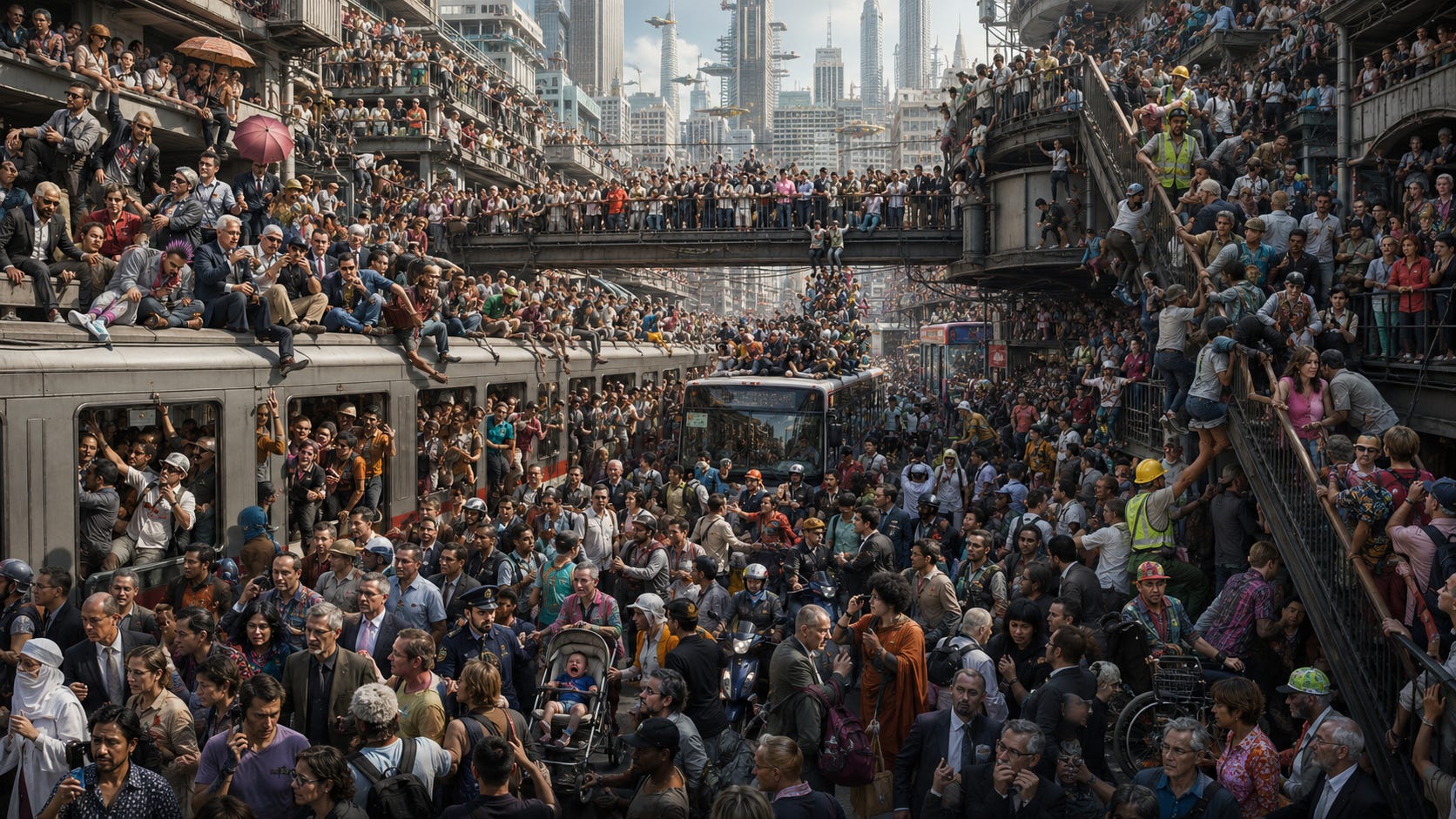
I recently came across a video, which I posted on our Telegram channel, stating that the top 300 cities in the world held about a billion people, while the UN states that in 2025, there were 8.2 billion souls roaming the planet.
That intrigued me. I’ve long suspected the global population numbers were a bit swollen, and this new information seemed to confirm that suspicion.
So, I warmed up my friendly neighborhood AI and I asked it to give me the total population of the 500 largest cities in the world based on multiple “credible” sources. Here’s what I got:
Using the UN DESA World Urbanization Prospects 2025 framework, the total population of the 500 largest urban centres / urban agglomerations is approximately:
1.8 billion people
“I would quote it as about 1.8 billion, not a false-precision number, unless working directly from the downloadable UN/JRC bulk table. The relevant “latest reporting period” is 2025, and the UN’s updated WUP 2025 dataset covers over 12,000 cities of 50,000+ inhabitants, using the harmonised Degree of Urbanization method. Under that method, a “city” is not a municipal boundary but a contiguous urban centre built from 1 km² grid cells with at least 1,500 inhabitants/km² and a total population of at least 50,000.
“For scale: the world’s total population in 2025 was about 8.2 billion, and UN WUP 2025 says cities contained about 45% of that total, so all UN-defined cities together held roughly 3.7 billion people. The top 500 therefore account for roughly half of the world’s city population, which passes the smell test.”
I’m not sure which smell we’re testing for, but the one I’m getting is a tad disagreeable. According to the UN’s broad definition of a “city,” there are 3.7 billion people living in 12,000 cities. Let’s allow that to sink in for a moment.
Curious, I asked the AI Oracle to show me global population numbers from 1800 to today, using the most “credible” sources. I whittled it down to 50-year increments to spare you the tedious table:
“Our World in Data states its long-run population series uses Gapminder for 1800–1949 and UN World Population Prospects 2024 from 1950 onward; Gapminder similarly identifies its pre-1950 base as Maddison/CLIO/Gapminder and post-1950 as UN WPP.”
1800 ~990 million
1850 ~1.26 billion
1900 ~1.65 billion
1950 2.493 billion
2000 6.172 billion
2026 8.301 billion
After considerable mind-numbing mathematics, what I came up with is this: roughly half the population is female. Of that group, about half are of child-bearing age (15-49), and the global average birth rate per woman is 0.6/year. I also came up with a rough death rate of about 10% of the total population per year. All of this is using the average of three sources pre-1950, and the World Bank and UN numbers from 1950 onward. This yields a population growth factor of 1.0575/decade with the formula:
Next decade population = current population × 1.0575
Using 1800 as the baseline, this gives us a model result like this:
1800 990.0 million
1850 1.309 billion
1900 1.731 billion
1950 2.289 billion
2000 3.027 billion
2026* 3.500 billion
Now I’m the last person you’d want doing math for you, but I did have help from my friendly neighborhood AI, whose “brain” is built out of maths, so blame it.
However, using all these official numbers and coming up with a factor that I could multiply by total population each decade, with 1800 as my baseline, I cam up with an estimated 3.5 billion souls on Earth. According to the UN calculations, there are 3.7 billion souls living in the 12,000 largest cities on the planet.
I don’t know about you, but it seems beyond coincidental that my key-and-phosphor scratchings come up in the same neighborhood as the UN’s estimate of all folks living in cities with 50,000+ populations. I also find it stretches credulity to say that 4.5 billion people are farmers, nomads, gypsies, or stone-age jungle dwellers.
We know that lots of money is distributed on a global scale based on population estimates. That clearly incentivizes governments to lie about their population numbers, over and above the fact that governments lie all the time about everything anyway.
Over estimating populations also serves the Malthusians and those seeking to create false shortages. The overcrowding myth serves many interests who profit from scarcity of resources, and they usually connected to the organizations who distribute “aid,” as well.
Just to put all this in perspective, if every human on the planet moved to Texas (and who could blame them?), each of them—children included—would have 902 ft²/84 m² to stretch out in. If we’re talking 4 billion souls, which I think is closer to the truth, then a family of four gets a pretty sizable spread.
I’m sure just about everyone reading this is better at math than I am, and all the data is freely available from the noted sources. Do your own calculations and see what you come up with. Feel free to post the results in the comments. I’d be very interested to see what we all find.
Humanity lives in a very narrow band across the middle latitudes of Earth, and we tend to congregate in large population centers. If you live with the majority of humans, then you might tend to think we’re overcrowded. But trust me, there are still huge spaces where you can live comfortably and not see another human for years, perhaps even decades. Perception is not reality.
If you’re feeling particularly overcrowded, I can recommend camping in parts of West Texas or anywhere in New Mexico. After a week, you’ll be begging for a crowd.
Si mundus vult dicipi, ergo dicipitatur.
=====
There is a strange little film for today’s topical tailgater, called either ZPG or Dead Planet (1972), depending on when your copy was released. It is one of a rash of movies put out during the Malthusian orgy of the 1970s. It stars Oliver Reed and Geraldine Chaplin, so it was targeted at a mass audience, but it has that distinct 70s weirdness about it. For a more recent and somewhat more approachable film, see What Happened to Monday (2017), with Willem Dafoe and Glenn Close.
Fighting for space on the Far Side:
Home Site / Old Blogger Site / LinkedIn / Farcebook / IMdB
E-book: Paper Golem: Corporate Personhood & the Legal Fiction
Contact Bernard Grover: bernard (at) radiofarside (dot) com
Radio Far Side, published (mostly) every Sun/Wed at 7a CST/7p WIB, is a labour of love. We don’t use a paywall, and we don’t sell stuff. We just create things to inform and entertain. Like any good busker on the digital mean streets, we put our hat down and if you feel inspired, drop a coin in to show your appreciation:
BTC wallet: bc1qth6drgzcyt7vlxxpvqh6erjm0lmaemwsvf0272
XRP wallet: rMSQzLyE3RHacCLwYPADBbq4RHQ71HpCzw

I can't travel, and so spend time watching news & videos from around the world. I'm struck by how people who have nothing else, have cell phones. And by how many children have them. Recently there were estimates of 5 billion cell phones, with no guarantee for how many still work, what belonged to companies, etc. Sorry not to provide a link, I didn't know this interesting article would be popping up. I mention this because I think there are many clues that point to lower population numbers than we're given. Demographics and statistics are used and abused in many ways. As a vintage human 🙂, there's not too much I believe any more.
Well now--very interesting article here Mr. Farside. Of course, I have long known that official narrative is just another word for lie, so don't believe much of what I read or hear, and even suspect the old eyes at times. Fortunately, here on the ranch the population is limited to just me, along with all the various critters that make the place a ranch, This has been a good week--had an appointment over in the county seat on Monday, and another coming on Friday, but the rest of the time, the only trips out the front gate have been to collect the mail from the box down on the FM --a half mile down a caliche drive. Personally. I really like the solitude this part of Texas provides a guy who really doesn't like being around other two legged critters very much at all--possible the end result of being raised up in one of those big east coast city row house neighborhoods.