Those of us of an age remember penmanship class roundabouts the Second Grade. We also remember English having 27 characters in the alpha-beta, or alphabet if you prefer. The last character after ‘z’ was ampersand, or ‘&’, which is just a stylized “Et” meaning “and”. When penmanship died, so did & as a rote character in the English language, and arguably so did the language itself.
Spell, meaning “to form words letter by letter”, comes from Old English spellian, meaning to tell, speak, relate, discourse. That sense developed into “read out” or “name the letters”, then into the modern “spelling”.
Thanks for reading RadioFarSide’s Teletype! Subscribe for free to receive new posts and support my work.
Spell, meaning “a magical charm or incantation”, comes from Old English spell, meaning speech, saying, tale, narrative, message. A magical spell was originally something spoken—a formula, charm, or ritual utterance. The magic was in the words.
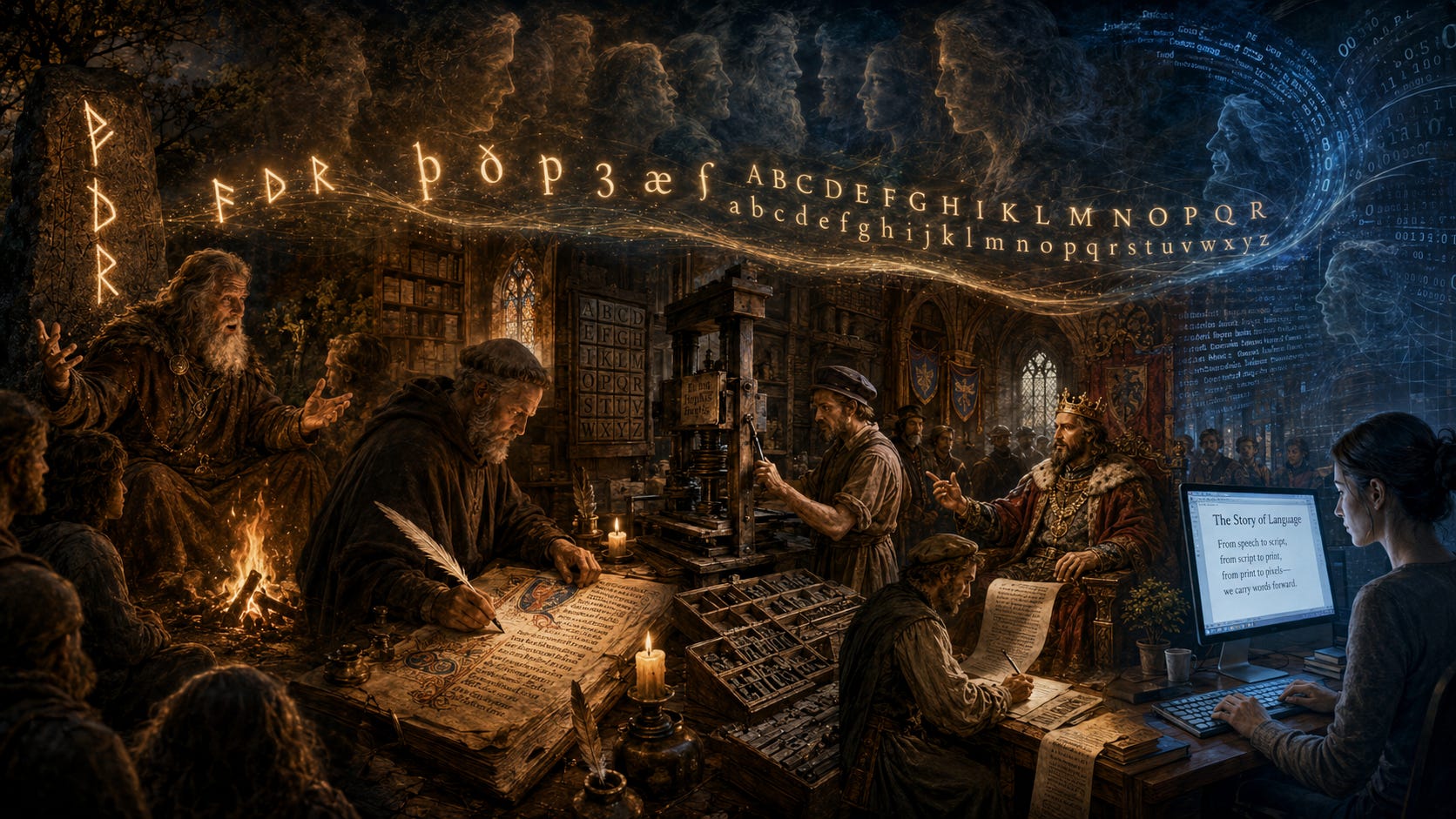
English did not always march under the tidy 26-letter regime we know today. Old and Middle English used several letters that later disappeared, mostly because English writing was forced into the Latin alphabet, then standardized by Norman French scribes, continental printers, and eventually spelling conventions. In short: invasion, bureaucracy, printing presses—the usual suspects.
Thorn — þ — represented the ‘th’ sound. It came from the runic writing tradition and was absorbed into Old English writing. It could represent both the unvoiced th of thin and the voiced th of this, because Old English spelling was not yet burdened by modern schoolmasters pretending spelling is logic. Thorn remained common into Middle English, but the digraph ‘th’ gradually took over.
The great misunderstanding is “Ye Olde”. In many late medieval and early modern printed texts, thorn began to resemble y, and imported printer’s type often lacked a thorn character. So printers substituted y. That means “ye olde shoppe” was originally closer to “the old shop”, not “yee old shop”. Anyone pronouncing it “yee” is doing historical cosplay with a loose wig.
Eth — Ð/ð — also represented a ‘th’ sound. In Old English, thorn and eth were sometimes used inconsistently, even by the same scribe. Later, English abandoned both and settled on th. Icelandic, being admirably stubborn in the old northern way, still uses both þ and ð today.
Old English needed a ‘w’ sound, but classical Latin did not have a native letter for it. So English used wynn — ƿ — borrowed from runic tradition. Over time, scribes began writing ‘uu’ or ‘vv’, which eventually became ‘w’, literally “double-u”. Wynn died because w was typographically easier and increasingly standard across scribal and printing practice.
Yogh — ȝ — is one of the more interesting casualties because it represented several sounds depending on period and region: a ‘y’ sound, a hard or soft ‘g’, or the guttural sound, like hawking a loogie, later written ‘gh’, as in older pronunciations of night, laugh, or loch-type sounds.
When yogh disappeared, scribes replaced it inconsistently. Sometimes it became gh. Sometimes y. Sometimes g. In Scottish names, it was sometimes confused with z, which is why Menzies is traditionally pronounced closer to Mingis, and Dalziel closer to Dee-ell or Dee-yell, depending on tradition. This is spelling archaeology: the fossil is still visible, but the animal is long dead.
Ash — æ — represented a front vowel sound, something between ‘a’ and ‘e’. It sounded a bit like the British “aw” for the letter ‘a’ in modern dialects. Old English used it as a genuine letter, not merely a decorative ligature. Modern English retains it mostly in specialist, archaic, or scholarly contexts, such as Anglo-Saxon transcriptions. In ordinary spelling, it was replaced by a, e, or ae. Fælty Towers, anyone?
Examples include Old English æsc, which becomes modern ash, and dæd, which becomes deed.
Œ / œ, often called ethel, is less central to native English than thorn, eth, wynn, or ash. It is mostly associated with Latin and Greek-derived words. Older British spelling sometimes preserved it in words such as fœtus, œconomy, or subpœna, though modern spelling has largely simplified these to foetus, economy, and subpoena. This one was less “lost Anglo-Saxon heritage” and more “classical typography finally gave up wearing a powdered wig”.
The long s — ſ — was not a separate letter in the phonetic sense. It represented s, especially at the beginning or middle of words. It is the reason old printed texts appear to say things like “Congrefs” when they mean “Congress”. The long s fell out of use around the late eighteenth and early nineteenth centuries as type design and publishing conventions modernized.
It disappeared not because English lost a sound, but because printers and readers collectively decided the thing looked ridiculous. Correct decision.
The Tironian ‘et’ — ⁊ — was a shorthand symbol meaning ‘and’, rather like the ampersand ‘&’. It came from Roman shorthand and survived in some manuscript traditions. It is not usually counted as a full English alphabet letter in the same way as thorn or wynn, but it did function as a common written character.
English spelling looks chaotic partly because it is a museum of abandoned technologies. We kept the sounds, lost many of the letters, then patched the damage with digraphs and inconsistent spellings. Thorn became th. Wynn became w. Yogh became a whole drawer full of trouble. Ash faded into ordinary vowels. Long s became a typographic embarrassment.
The modern alphabet is not more logical. It is merely the version that survived the committee meeting. English spelling has been horribly mangled by cultural invasions, imported printing presses, and evolutionary pronunciation, making it one of the worst writing systems around (Gaelic being the standard bearer).
One last note: the ending -ed for regular Past Simple and many Past Participles used to be fully pronounced, as in the adjective “learned” today. Around the time of Shakespeare, though, it broke up into three distinct sounds, depending on the last sound in the root word. We now have d/t/id for the same two letters. This is apparent in words like summed, walked, and waited.
So, with all your new learnings, how about taking on Chaucer in his native tongue? Here’s the opening of The Canterbury Tales for your entertainment—remember almost every letter is pronounced:
Whan þat Aprill wiþ his shoures soote Þe droȝte of March haþ perced to þe roote, And baþed every veyne in swich licour, Of which vertu engendred is þe flour; Whan Zephirus eek wiþ his sweete breeþ Inspired haþ in every holt and heeþ Þe tendre croppes, and þe ȝonge sonne Haþ in þe Ram his half cours ȝronne…
See how easy that is?
=====
I have to go with Braveheart (1995) for today’s cinematic tie in, not because it accurately recreates medieval language, but because it dramatizes the cultural stakes behind language, identity, conquest, and historical memory. Watch it for atmosphere, myth-making, and the politics of speech—not for orthography, costume history, or medieval phonology. And I don’t care what anyone says, Stephen is the hero, even though I look like Hamish.
Contact Bernard Grover: bernard (at) radiofarside (dot) com
Radio Far Side, published (mostly) every Sun/Wed at 7a CST/7p WIB, is a labour of love. We don’t use a paywall, and we don’t sell stuff. We just create things to inform and entertain. Like any good busker on the digital mean streets, we put our hat down and if you feel inspired, drop a coin in to show your appreciation:



My mother's favourite example of "Yogh" as each word has a different pronuciation of the same letter arrangement.
"The tough coughs as he ploughs through the dough".
Gives an entirely new meaning to "spelling bee".