
Word Nerd Gets Glamourous
Pulling the wool over your eyes

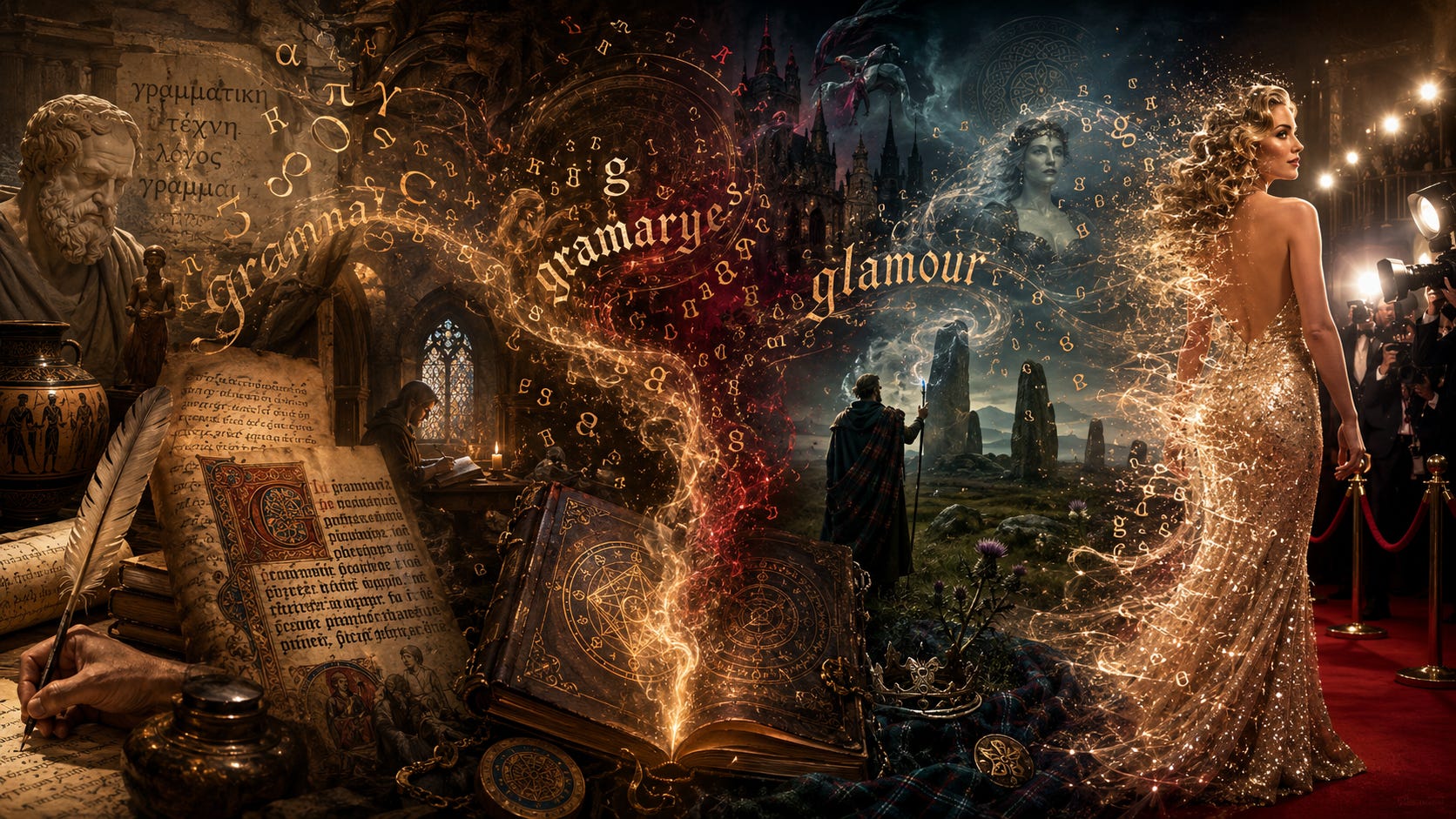
Glamour. The beauty and personal care market is projected to be USD700 billion in 2026. People hunger for glamour, they read about glamour, they follow glamour trends, they self-mutilate for glamour, they even kill for glamour.
If you include:
beauty and personal care
luxury fashion and accessories
salons and beauty services
cosmetic procedures
modelling, photography, advertising
celebrity media and influencer marketing
film, television, red-carpet culture
wellness aesthetics and grooming
then you are plausibly talking about a multi-trillion-dollar global appearance economy.
And that’s because “glamour” is occult magic. Don’t believe me? Keep reading.
Glamour has mundane, perhaps even boring beginnings. It’s actually a Scottish variant on the word “grammar”. I know, bizarre right? But not really. This etymological and linguistic journey has many dark twists to it. Buckle up! We’re leaving on an Indiana Jones-style adventure seeking the Holy Grail of Glamour.
To the modern English speaker, glamour conjures up images of movie stars, haute couture, and lifestyles of the rich and heinous. We think of red carpets and runways, fashion and wealth, and that professional profile headshot. And in a sense, that is truly glamour, since it’s all an illusion, and glamour begins with magic.
The origins of glamour are interesting in their own rights. It starts with Greek, of course, gets high-jacked by Latin, receives a coif in French, gets dropped off in England, then the Scots get ahold of it.
The key root in Greek is graphein, meaning to write, draw, or mark. It has many cousins, including graph, graphic, paragraph, photograph, autograph, and many more. Grammatikē technē—the art of letters—grew from gramma meaning “letter, written mark, writing”—which came from graphein.
Latin stole graphein, as it was wont to do, and the word became grammatica. In Old French it evolved into gramaire / grammaire, then gramer/gramere in Middle English. Fun fact: if you notice a similarity between the Old French gramaire and the word grimoire—a manual of demons—then you’re starting to see clearly.
Here’s where it gets interesting: “grammar” originally meant “the act of acquiring knowledge”. It makes sense, since our modern definition is “the structure by which knowledge is transmitted”. However, when the Scots got it, the connotation specifically shifted to “occult knowledge,” and thus was related to “spelling,” or use of incantations, speech, words to enchant or bewitch. (see Word Nerd Casts a Spell).
The rough chain is:
→ Greek grammatikē — the art of letters
→ Latin grammatica — grammar, learning, philology
→ Old French gramaire / grammaire — grammar, learning; also magical incantation/spells in some medieval usage (see grimoire)
→ Middle English grammar — Latin grammar, scholarship
→ Scottish gramarye / glamour / glamer — occult learning, magic, enchantment
→ Modern English glamour — enchantment, then alluring beauty, then celebrity/fashion aura
The key historical shift is not that school grammar directly became lipstick-and-red-carpet glamour overnight. The bridge was learned language as mysterious power. In the medieval world, the person who knew Latin, manuscripts, astrology, theology, medicine, calendars, charms, and strange symbols could easily look like a magician or alchemist to the unlettered.
Etymonline gives glamour from Scottish glamer, recorded around 1715, meaning “magic, enchantment,” as a variant of Scottish gramarye, itself tied to grammar in the medieval sense of scholarship, especially occult learning.
This notion of glamour as illusion is not limited to medieval Scotland. Across time and culture, human beings have repeatedly suspected that perception is not reality, but a veil thrown over it.
Sanskrit gives us māyā, the great illusion or appearance by which the world is perceived, but not necessarily understood. Greek philosophy gives us Plato’s cave, where ordinary people mistake shadows on a wall for truth. Medieval Europe gives us enchantment, glamour, and the magician’s art of making one thing appear to be another. Different languages, different costumes, same old suspicion: the eye is easily fooled, and the mind is often worse.
That is why glamour survives so comfortably in the modern world. We may no longer believe a Scottish witch can cast a glamour over a milk cow or a handsome prince, but we absolutely believe in lighting, make-up, filters, branding, celebrity photography, luxury packaging, and social media illusion.
The spell did not vanish; it got better distribution. Glamour is perception edited for effect. It is māyā with a marketing department, Plato’s cave with a ring light, and medieval enchantment reborn as an industry worth hundreds of billions of dollars.
There is danger in beauty, and beauty in danger, as Gary Jennings noted in The Journeyer.
If you’ve read this far, then I have successfully cast a glamour upon you. From now on, when you think of Hollywood-style glitz-and-glamour, or glamour photography, or glamour magazines, it will always be associated with magic, occult and enchantment (chanting spells). My lexical alchemy has changed your worldview forever.
And it didn’t cost you a thing.
Bonus fun fact: “thank” is related to “think”. It comes from Old English þanc, meaning thought, goodwill, gratitude, from a Germanic root connected with mental activity. The original idea was not merely saying “cheers” after someone passes the salt; it was closer to holding someone in favorable thought. So when you thank someone, you are, etymologically speaking, saying: I think well of you for this. Gratitude as thoughtful esteem. So, thank you for coming along for the ride.
Si mundus vult dicipi, ergo dicipitatur.
=====
There is a perfect cinematic companion for today’s screed: Excalibur (1981). It is one of John Boorman’s best films—visually rich, tight narrative with a satirical edge, interesting characters, great costumes, and a memorable score. Nicol Williamson’s Merlin is by far the best rendition of the character ever, and he spends the entire film living and breathing glamour.
Get bedazzled on the Far Side:
Home Site / Old Blogger Site / LinkedIn / Farcebook / IMdB
E-book: Paper Golem: Corporate Personhood & the Legal Fiction
Contact Bernard Grover: bernard (at) radiofarside (dot) com
Radio Far Side, published (mostly) every Sun/Wed at 7a CST/7p WIB, is a labour of love. We don’t use a paywall, and we don’t sell stuff. We just create things to inform and entertain. Like any good busker on the digital mean streets, we put our hat down and if you feel inspired, drop a coin in to show your appreciation:
BTC wallet: bc1qth6drgzcyt7vlxxpvqh6erjm0lmaemwsvf0272
XRP wallet: rMSQzLyE3RHacCLwYPADBbq4RHQ71HpCzw

The only reason I follow you is because you're so glamorous.
Etymology online also has the following to say.
Jamieson's 1825 supplement to his "Etymological Dictionary of the Scottish Language" has glamour-gift "the power of enchantment; metaph. applied to female fascination." Jamieson's original edition (1808) looked to Old Norse for the source of the word. Zoëga's Old Icelandic dictionary has glám-sýni "illusion," probably from the same root as gleam.
I would have said there's danger in the illusion of beauty and if one has ever seen the before and after make-up photos of models, actresses, etc., I think there would be agrrement that it is the illusion of beauty that is deceptive.
As for Nicol Williamson, he had a reputation for a volatile temperament and slapped an actor during a curtain call for the Broadway musical Rex, struck a producer during a play tryout and hit a co-star with a sword during a production of I Hate Hamlet, which somewhat reduces the "glamour" of his role in Excalibur.