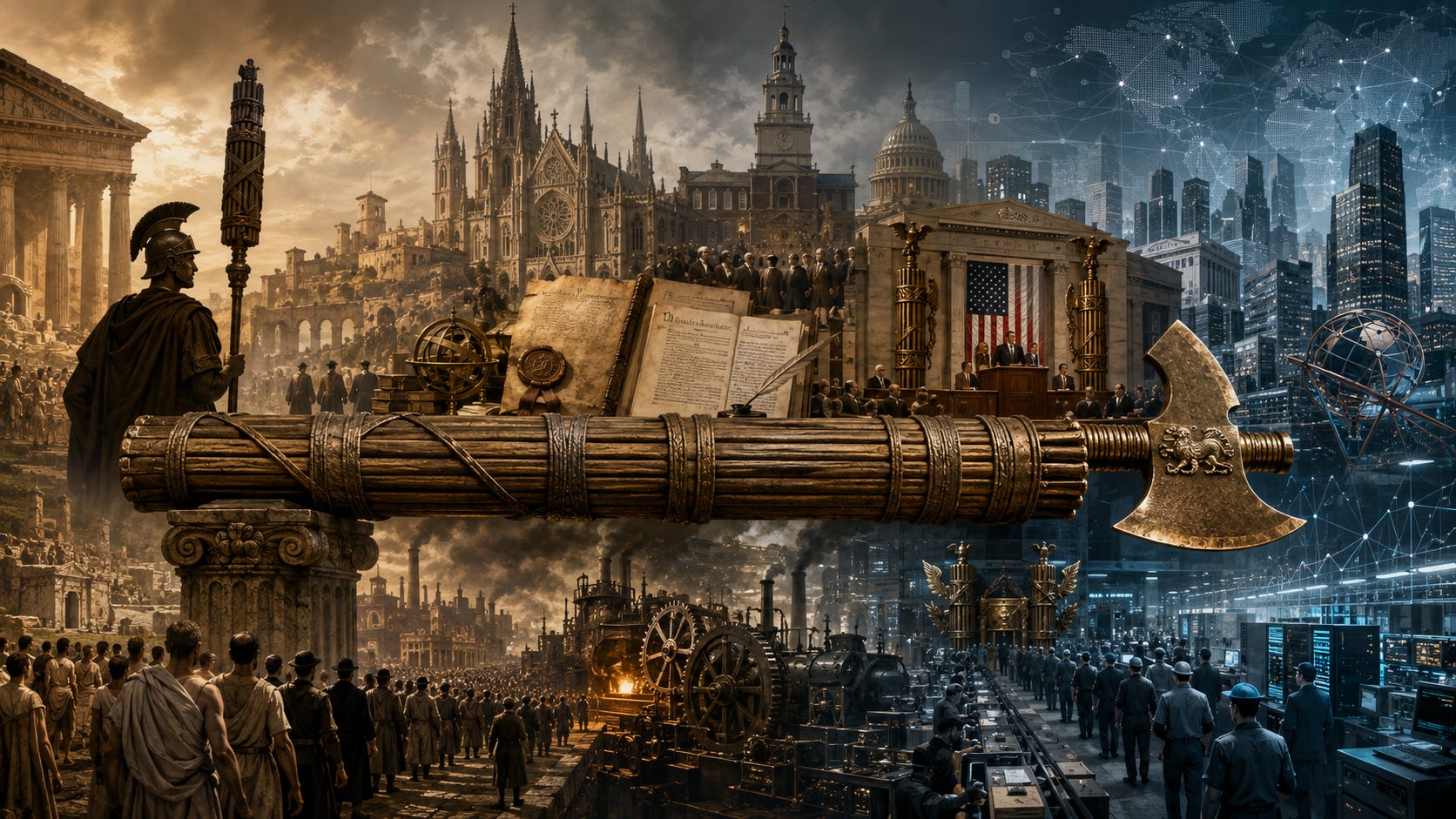
Behind the Speaker’s rostrum in the United States House of Representatives, flanking the American flag, are two bronze fasces: bundles of rods bound around an axe, inherited from the symbolic vocabulary of Rome. They are not decoration in the casual sense. They are an argument in metal.
The rods represent the strength of the many bound into one. The axe represents the state’s power to punish, command and, in the final instance, kill. Long before Mussolini borrowed the symbol and gave the twentieth century the word fascism, the fasces expressed a colder and older idea: power begins when human beings are bundled into a corporate body.
Thanks for reading RadioFarSide’s Teletype! Subscribe for free to receive new posts and support my work.
The fasces — plural of the Latin fascis, meaning “bundle” — were a Roman symbol of state authority and coercive legal power. They were carried before magistrates, and before some provincial governors, by lictors, a cross between ceremonial bodyguards, bailiffs, and executioners.
The rods symbolized collective strength and corporal punishment. The axe symbolized capital authority. The symbol said, without needing to raise its voice, that the many had been bound into one, and that the one had teeth.
As an important aside, lictor is commonly explained as deriving from the Latin ligare, meaning “to bind,” though the etymology is not beyond dispute. Either way, the symbolic logic is clear enough: the lictor carried the bound rods, the rods represented bound power, and the authority of the state travelled in front of the magistrate like a warning label with sandals.
Modern English preserves the same root in words such as ligament, ligature, obligation, liable, and possibly religion. Binding is not merely a physical act. It is legal, moral, political, and spiritual.
The word ‘corporate’ comes from Latin corpus, meaning body. To incorporate is to create a body from separate parts. A corporation is a group legally treated as a single person or body. It can own property, make contracts, sue, be sued, and continue existing even as individual members come and go.
Modern English often reflects this legal fiction by treating the corporation grammatically as a singular actor: the company owns, the company decides, the company is responsible. In theory, anyway. In practice, responsibility tends to evaporate somewhere between the boardroom, the legal department, and a very expensive lunch.
For those who have read my brief but informative book Paper Golem: Corporate Personhood and the Legal Fiction, you will recognize the deeper argument. The modern corporation did not fall from the sky wearing a necktie. It developed over roughly 4,000 years, from Sumerian temples and civic institutions, through the Roman Empire, through the corporate power of the Roman Catholic Church, through medieval guilds and chartered towns, through trading companies, municipalities, universities, and finally into the modern legal fiction that now walks among us with rights, property, political influence, and no soul to trouble the accountants.
Corporations are not limited to governments or commercial companies. In the older and broader sense, a corporation is any legally recognized body that allows many individuals to act as one enduring entity. Today, that category includes religious institutions, universities, professional associations, charities, non-governmental organizations, trade unions, foundations, political parties, clubs, municipalities, and countless other forms of collective organization.
The essential feature is not profit, but legal personhood. The incorporated body can own property, enter contracts, receive donations, hire staff, sue and be sued, and continue existing even as its individual members, officers, trustees, shareholders, or citizens come and go.
Incorporation turns a temporary collection of people into a continuing legal body — a corporate person that outlives the flesh-and-blood persons who compose it.
Governments can be understood as corporate bodies in this older legal and political sense. They are groups of people, usually called citizens, organized as a single public entity. In theory, that entity claims to hold the people’s sovereignty in public trust.
The citizens are something like shareholders with voting rights, who supposedly benefit from incorporating a government and lending it their collective power to act in their best interests.
Note the word supposedly. This is the concept, not necessarily the reality. Anyone who has stood in line at a government office understands the distinction.
The concept of the nation-state emerged gradually. The usual historical answer is that it began taking recognizable form in early modern Europe, especially from the sixteenth to eighteenth centuries, and became dominant in the nineteenth and twentieth centuries.
The Peace of Westphalia in 1648 is often treated as a landmark in the development of the sovereign territorial state, though the full modern nation-state belongs more properly to the later age of nationalism, revolution, mass literacy, bureaucracy, passports, flags, schoolbooks, standing armies, and young men being told they are lucky to die for an abstraction.
The key distinction is this: a state is a political and legal structure — territory, government, laws, taxation, army, borders. A nation is a people imagined as sharing common identity: language, history, culture, ancestry, religion, myth, destiny, political loyalty, or some useful combination of all the above.
A nation-state is the attempt to make those two things coincide: one people, one territory, one government. That ideal is rarely achieved cleanly, but it has been the organizing fantasy of modern politics for two centuries.
This concept is symbolized beautifully, and somewhat ominously, by the fasces: projecting power through binding. The axe is authority. The rods are the many. The cord is the legal, political, cultural, and administrative ligature that turns a population into a state. Bundle the sticks tightly enough, and the individual twig disappears into the weapon.
To drive home the point, fasces have appeared in the visual program behind the Speaker’s rostrum in the US House of Representatives since the 1857 House Chamber design. During the 1949–1950 renovation, the earlier decorative scheme was updated, and the current bronze relief fasces were mounted on either side of the American flag. This is not a Mussolini import. The American use predates Italian Fascism by decades.
Rome had already done the branding work. Modern states merely kept the logo.
Within this framework, a modern constitution may be understood as the Articles of Incorporation of the nation-state. It establishes the corporate body politic, defines its governing offices, distributes authority among its branches, identifies the rights and obligations of its members, and sets the lawful limits of institutional power.
Just as a corporation exists as a legal person distinct from its shareholders, directors, and officers, the state exists as a continuing legal and political person distinct from any particular ruler, parliament, ministry, party, president, monarch, or generation of citizens.
The constitution is therefore not merely a statement of ideals. It is the founding instrument by which the people, territory, institutions, and sovereign authority of the state are organized into one enduring corporate body.
This does not mean every corporation is fascist, nor that every incorporated state is fascist by definition. That would be too easy, and therefore probably wrong.
The point is narrower and more dangerous: fascism arises when the corporate body ceases to serve the persons who compose it, and instead demands that those persons justify their existence by service to the corporate body. The legal fiction becomes a moral sovereign. The instrument becomes the master.
Mussolini defined Fascism as a totalizing nationalist political movement centered on the absolute authority of the State. His formula was blunt enough to be printed on a shovel: Everything within the State, nothing outside the State, nothing against the State.
In The Doctrine of Fascism, published in 1932 and attributed to Mussolini, though substantially shaped by Giovanni Gentile, the key idea is that the State is not merely an administrative tool. It is the supreme moral, political, and spiritual organism of the nation. The individual has meaning only insofar as he is part of that State.
Mussolini wrote that the Fascist conception of the State is “all embracing” and that outside it “no human or spiritual values can exist.”
There it is. No need for conspiracy theories, decoder rings, or midnight meetings in candlelit cellars. The doctrine says the quiet part in parade-ground Italian. The State is the body. The individual is a cell. Cells do not negotiate with the body. Cells serve, reproduce, die, and get replaced.
In contemporary geopolitics, the contest is not simply between globalism and nationalism, but between two competing models of incorporation.
The first model seeks to harmonize states into an increasingly centralized global system of rules, standards, metrics, courts, markets, compliance regimes, financial transparency, environmental targets, development goals, digital protocols, and technocratic institutions — a corporation of corporations, so to speak.
This is not world government in the cartoon sense of a bald villain stroking a cat under a blue flag. It is quieter, duller, and probably more durable: governance by forms, dashboards, ratings, treaty obligations, eligibility standards, institutional incentives, and expert consensus. No jackboots required. Sensible shoes will do.
The second model accepts the existence of a global order, but insists that its members remain distinct sovereign bodies acting in concert rather than being absorbed into a single managerial architecture.
It does not necessarily reject hierarchy, centralization, surveillance, bureaucracy, or coercion. Several of its leading states are enthusiastic practitioners of all five. What it resists is Western custody of the rulebook.
In this sense, the rough distinction between the OECD-aligned world and the BRICS world is not trivial, though it should not be overstated. The OECD tendency is toward regulatory convergence, policy harmonization, common standards, financial transparency, and managerial integration, both domestically and internationally.
The BRICS tendency is less a unified doctrine than a revolt against Western custody of the charter: a demand that sovereign blocs bargain with one another rather than submit to a single board of auditors. It is institutionalized haggling on a global scale.
The argument is not whether the world will be organized, but who writes the charter, who sits on the board, and whether the member-states remain shareholders or become departments.
In both models, the individual human being risks becoming incidental. Whether power is centralized through a supranational managerial order, or distributed among competing sovereign blocs, the person is too often reduced to fuel for the machinery: worker, taxpayer, consumer, soldier, voter, debtor, patient, student, data point, and reproductive unit for the next generation of the same system.
Human beings become the firewood powering the steam engine of corporate authority, producing the economic grist for the mill, while being assured that the mill exists for their benefit. The individual life may be praised in rhetoric, sanctified in charters, celebrated in slogans, and mourned tastefully when necessary, but in practice it is frequently treated as replaceable.
The System of Systems does not require any particular man or woman to matter. It requires only that the next cohort arrive on schedule trained, indebted, credentialed, trackable, compliant, productive, and ready to feed the machine.
One generation is bundled, burned, and memorialized. The next is marched forward carrying better phones. Each gets their brand and group identity: Boomer, Xer, Millennial, Zoomer, Alphas. Not unlike Huxley’s Brave New World.
The argument, then, is not whether modern life will be organized through corporate bodies. That question has already been settled. The real question is whether those bodies will remain instruments of human purpose, or whether human beings will be reduced to instruments of corporate survival.
At that point, the old distinction between competing political systems begins to look suspiciously like Henry Ford’s famous promise about the Model T: “Any customer can have a car painted any color that he wants, so long as it is black.”
The menu of systems may look expansive. The machinery underneath is increasingly the same.
Si mundus vult dicipi, ergo dicipitatur.
=====
There are so many great films on the subject of fascism/corporatism, but I have settled on Bernardo Bertolucci’s brilliant The Conformist (1970), dramatizing the individual’s submission to the State in the guise of Italian Fascism. If you want a Sunday afternoon double feature, pair it with Network (1976), the Paddy Chayefsky/Sydney Lumet masterpiece that is essentially the same story told from an American point of view.
Looking for love in all the wrong fasces on the Far Side:
Contact Bernard Grover: bernard (at) radiofarside (dot) com
Bernard Grover is a writer, producer, and communications strategist with more than four decades of international experience spanning business, media, theatre, and public policy. His essays explore the intersections of history, language, law, economics, culture, and political philosophy, with a particular interest in the unintended consequences of institutions and ideas.
Radio Far Side is published (mostly) every Sun/Wed at 7a CST/7p WIB, as a labour of love. We don’t use a paywall, and we don’t sell stuff. We just create things to inform and entertain. Like any busker on the digital mean streets, we put our hat down and if you feel inspired, drop a coin in to show your appreciation:
The Borg represent the ultimate loss of individuality and free will to a totalitarian hive-mind. Corporations, states and the collective all fall into this category in which morality and ethics either cease to exist or function at the lowest common level.
Thanks for the excellent history lesson. The West and the U.S. in particular, is based on Christianity, Roman administration and jurisprudence, and Greek philosophy. It shows up, as you point out, in all our literature, laws, and legal documents.



The Borg represent the ultimate loss of individuality and free will to a totalitarian hive-mind. Corporations, states and the collective all fall into this category in which morality and ethics either cease to exist or function at the lowest common level.
Thanks for the excellent history lesson. The West and the U.S. in particular, is based on Christianity, Roman administration and jurisprudence, and Greek philosophy. It shows up, as you point out, in all our literature, laws, and legal documents.