
The Great Pigment Panic
For what it's worth

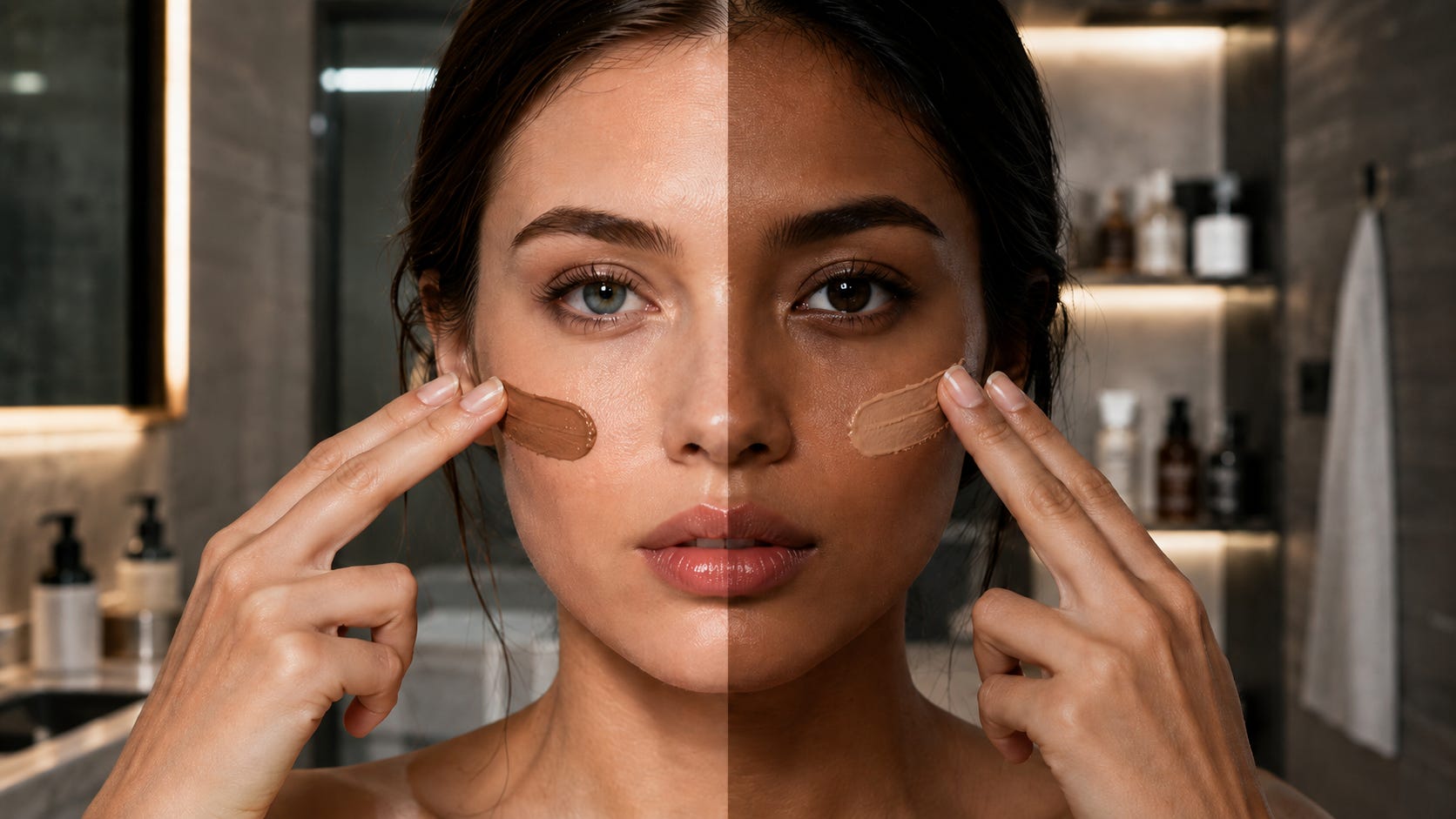
Human civilization has survived ice ages, plagues, wars, disco, and the LinkedIn motivational post. Yet we remain helpless before one ancient enemy: our own skin tone. Across Asia, millions of consumers buy creams, serums, soaps, capsules, injections, laser treatments, peels, deodorants, sunscreens, underarm brighteners, intimate-area lighteners, and suspicious little jars sold online by people whose medical credentials begin and end with a ring light.
Meanwhile, in the West, other millions lie under ultraviolet lamps, spray themselves bronze, swallow or sniff dubious tanning compounds, and roast on beaches like basted poultry. The East pays to become lighter. The West pays to become darker. The human species, having conquered flight and split the atom, still cannot look in the mirror without attempting a hostile takeover.
The numbers are not trivial. Grand View Research estimated the global skin-lightening products market at USD 11.20 billion in 2023, with a projected rise to USD 16.14 billion by 2030. Other market analysts put the 2024–2025 figures in roughly the same absurdly profitable neighborhood: Kings Research valued the market at USD 11.15 billion in 2024, with Asia-Pacific alone accounting for 35.05%, or about USD 3.91 billion. Fortune Business Insights estimates Asia-Pacific skin-lightening revenue at USD 5.52 billion in 2025, rising to USD 5.88 billion in 2026. Apparently, self-loathing scales very nicely.
The product range is magnificent in the way a military arms fair is magnificent. There are whitening face washes, whitening toners, whitening moisturizers, whitening night creams, whitening masks, whitening sunscreens, whitening body lotions, whitening deodorants, whitening toothpaste, whitening supplements, whitening injectables, whitening laser treatments, whitening drips, whitening peels, and enough “glow” vocabulary to power a minor cult.
The basic sales pitch is always the same: you are almost acceptable, but not quite. Fortunately, this tube of advanced nano-luminous pearl peptide radiance complex—roughly ninety-eight percent marketing fog and two percent moisturiser—can correct the tragic administrative error of your birth.
To be fair, not all skin-lightening products are sold as racial aspiration in a bottle. Some target hyperpigmentation, melasma, acne marks, sun spots, or uneven skin tone. Dermatology is real. Pigment disorders are real. Wanting to treat blotchy skin is not inherently deranged.
But the industry knows exactly where the money is, and it is not merely in clinical correction. It is in status anxiety. In much of Asia, paler skin has long been associated with class, indoor work, refinement, marriageability, and the delightful fantasy that one’s ancestors never had to stand in a rice field at noon. Colonial history poured gas on that fire, but it did not invent the flame.
Western tanning culture is the mirror image, only with more coconut oil and melanoma. In Europe, America, and Australia, tanned skin has been marketed as leisure, health, sex, travel, money, and moral superiority in swimwear. A tan says: “I am prosperous enough to lie motionless beside water.”
Once pale skin meant aristocracy; then industrial labour moved indoors, holidays became aspirational, and suddenly the desirable body was one that looked recently imported from a yacht. Thus the West turned the sun into a beauty consultant, which is impressive considering the sun’s main long-term service is cellular damage.
The self-tanning industry is smaller than the skin-lightening industry, but still handsomely ridiculous. Fortune Business Insights valued the self-tanning products market at USD 1.22 billion in 2025, projecting growth to USD 2.40 billion by 2034. Persistence Market Research expects the sector to reach USD 1.4 billion in 2026 and USD 2.1 billion by 2033.
So while Asian consumers are buying “radiance” and “fairness”, Western consumers are buying “bronze”, “glow”, “sun-kissed”, and “Mediterranean”, even when the consumer in question is from Leeds and has the natural undertone of printer paper.
The health risks form the usual fine print at the bottom of the vanity contract. The World Health Organization has warned about mercury-containing skin-lightening products, noting that some bleaching effects are achieved through harmful ingredients, including toxic mercury compounds.
The US FDA has also warned consumers against over-the-counter skin-lightening products containing mercury and/or hydroquinone, stating that there are no FDA-approved or legally marketed OTC skin-lightening products in the United States.
A 2025 study of 134 online skin-lightening cosmetics from seven Asian countries found that more than 58% exceeded the mercury limit of 1 mg/kg, with some samples reaching astonishing concentrations. That is not skincare; that is a chemistry accident with packaging.
The tanning side has its own circus. UV tanning is already an obvious problem, but the modern market has also produced nasal tanning sprays and melanotan-style products, promoted online with the scientific rigor of a drunk raccoon.
UK trading standards officers warned in 2025 about nasal tanning sprays linked to serious risks, including melanoma concerns and respiratory problems; some products contain melanotan 2, a synthetic hormone not approved in the UK. Naturally, influencers got involved, because no questionable health trend is complete until someone with veneers points at it on TikTok.
What makes the whole business so bleakly funny is that both markets sell the same lie in opposite colors. The whitening ad says: your darkness is the problem. The tanning ad says: your paleness is the problem. The solution, in both cases, is a recurring purchase. Beauty capitalism has achieved a kind of perverse diplomatic neutrality: it hates everyone equally, provided they have disposable income.
Asia’s whitening industry and the West’s tanning obsession are not contradictions. They are twins raised in different shopping malls. One worships porcelain; the other worships bronze. One fears the sun; the other books a package holiday to be slowly grilled by it.
Both convert insecurity into margin. Both dress up class anxiety, racial coding, sexual aspiration, and social conformity as “self-care”. Both whisper the same charming little message: nature made a mistake, but fortunately the checkout counter is open.
The tragedy is not that people want to look good. That is human, ancient, and mostly harmless. The tragedy is that entire industries have trained people to experience their own bodies as failed drafts.
Somewhere between whitening serum and tanning mousse, the obvious truth gets lost: the house always wins.
And the house, naturally, has excellent lighting.
Si mundus vult dicipit, ergo dicipitatur.
=====
In searching the archives to come up with something cinematic on topic, I found two films that compliments each other (or one if you’re not into subtitles). The first choice is Bala (2019), a Hindi-language comedy about a self-conscious balding man who sells whitening potions to self-conscious women. The second choice is Drop Dead Gorgeous (1999), a cult-level mockumentary about the murderous world of teen beauty pageants, starring my fantasy wife Ellen Barkin. Both are worthy of repeat viewings.
Radiant bronze on the Far Side:
Home Site / Old Blogger Site / LinkedIn / Farcebook / IMdB
E-book: Paper Golem: Corporate Personhood & the Legal Fiction
Contact Bernard Grover: bernard (at) radiofarside (dot) com
Radio Far Side, published (mostly) every Sun/Wed at 7a CST/7p WIB, is a labour of love. We don’t use a paywall, and we don’t sell stuff. We just create things to inform and entertain. Like any good busker on the digital mean streets, we put our hat down and if you feel inspired, drop a coin in to show your appreciation:
BTC wallet: bc1qth6drgzcyt7vlxxpvqh6erjm0lmaemwsvf0272
XRP wallet: rMSQzLyE3RHacCLwYPADBbq4RHQ71HpCzw

I am a western woman who has always honoured the "porcelain" she was born with and recognized early on that one's skin "eats" that which is applied to it. If you would not ingest it, do not wear it.
Well, I do have a farmer's tan. Does that count?