
The Icarus Factor
Where's Daedalus when you need him?

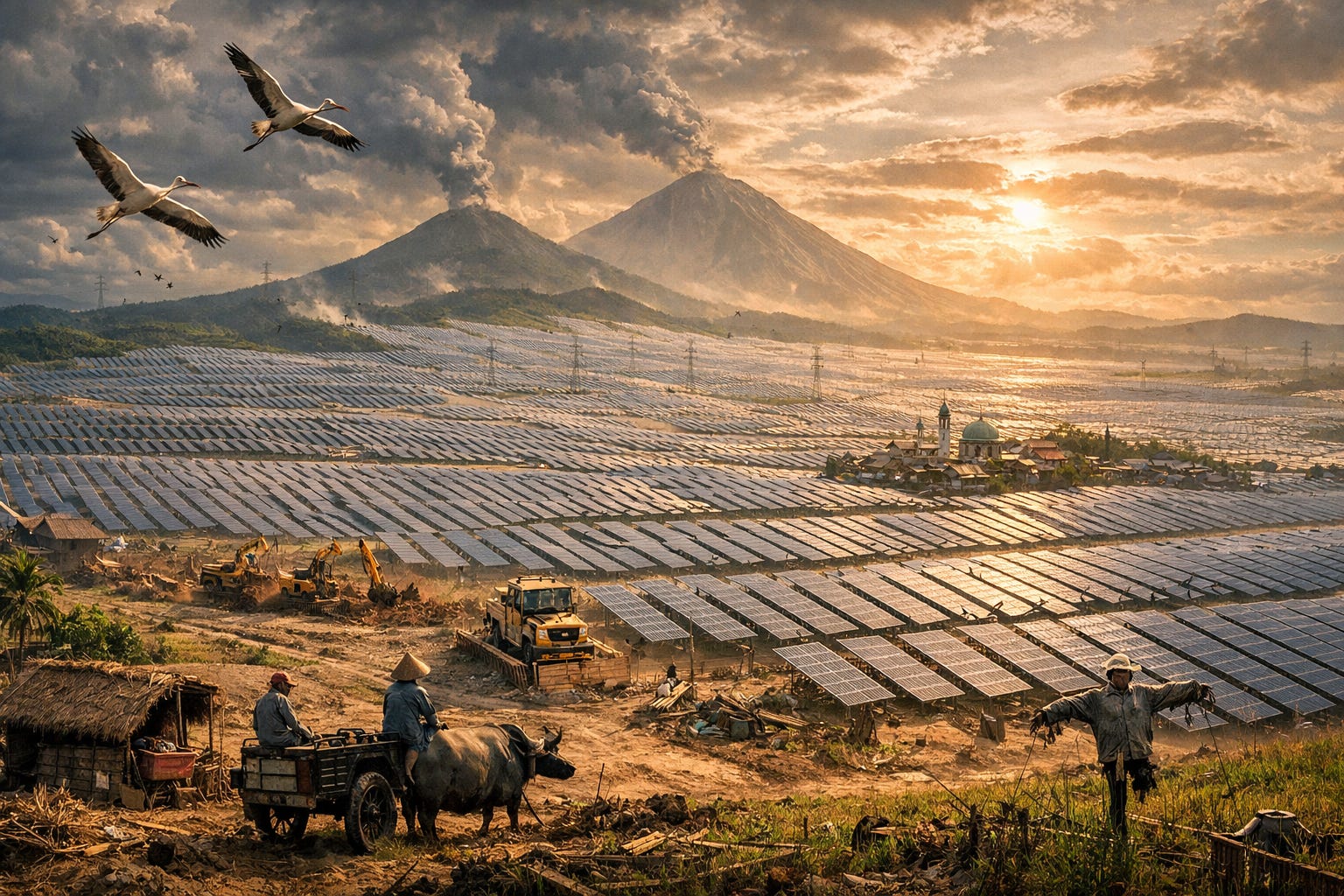
A buddy of mine recently attended a symposium called “Solar Archipelago,” at which a panel of what one assumes, at the risk of irony, to be rational and sober government types proposing the installation of 100 GW of solar PV power plants across Indonesia.
My mouth hung open, collecting a veritable zoo of equatorial insects. I was agog, which is almost onomatopoetic in this case.
This group pitches itself as a “think tank,” though I question the accuracy of that moniker. A comedy writing team would be more appropriate, especially since the cost of this fantasy would roughly equal the annual GDP of Africa.
Note that the “think tank” proposes 100 GW, though other sources discuss 80. I will use the “80” figure and let the reader add 25%, if additional laughs are required.
If one proposes—calmly, earnestly, with a PowerPoint deck and a laser pointer—that Indonesia should build eighty 1-gigawatt fixed photovoltaic (fPV) plants to deliver 80 GW of continuous, non-intermittent AC power, one is not proposing an energy project. One is proposing a civilisational redesign exercise.
Let us begin with physics, because physics does not attend cabinet meetings. Pay attention here, because the maths have caused permanent damage to my left frontal cortex and I don’t want it to be for naught.
Java, the industrial heart of Indonesia, enjoys respectable equatorial irradiance (amount of sunlight per square meter). Commercial fixed-tilt PV here typically yields a capacity factor in the 16–18% range under real-world conditions. That means a solar plant rated at 1 GW does not produce 1 GW around the clock. It produces, averaged over the year, roughly 160–180 MW.
If we require 80 GW delivered continuously—not “on a good afternoon in August,” but at 2:00 a.m. during monsoon season—then we must divide the desired output by the capacity factor. The arithmetic is unromantic:
80 GW ÷ 0.17 ≈ 470 GWp of installed PV capacity (GWp is gigawatt peak)
In other words, to average 80 GW, Indonesia would need something on the order of 450–500 GW of solar panels. Eighty 1-GW plants becomes five hundred of them in practice. The brochure will still say “80 GW.” The land will know the truth.
Utility-scale fPV typically requires around 2.5–3 acres per MWDC once spacing, tilt, access roads and inverters are included. Converting that to metric gives roughly 10–12 km² per GWp.
Apply that to ~470 GWp:
470 × ~11 km² ≈ 5,200 km²
If one adds overbuild to compensate for storage losses and resilience against extended cloud cover—as one must, if “non-intermittent” is to mean anything—the footprint drifts upward toward 6,000–8,000 km².
For perspective, the entire island of Java covers about 129,000 km². So the proposal implies dedicating roughly 4–6% of Java’s total land surface—or an equivalent area distributed across the archipelago—to panel fields.
That is not rooftops. That is not “a few brownfields.” That is a land allocation exercise comparable to carving out an area larger than Bali and declaring it permanently reflective.
And this is before discussing transmission corridors, substations, rights-of-way, and the small matter of persuading local populations that rice paddies are better replaced by tempered glass.
Solar produces in the day. Demand persists at night. Monsoon systems do not consult investor PowerPoint decks.
To smooth daily cycling alone—say 12 hours of full 80 GW output—you would require:
80 GW × 12 h = 960 GWh of battery storage
If the goal is genuine resilience against multi-day low-irradiance events, storage moves into the terawatt-hour range.
Utility-scale battery storage currently costs in the vicinity of USD 250–400 per kWh installed, depending on chemistry, integration and balance of plant. Using a restrained midpoint of USD 300/kWh:
960 GWh × $300/kWh ≈ USD 288 billion
And that only covers roughly half a day of autonomy.
Utility-scale PV construction in Southeast Asia presently falls roughly in the range of USD 800 million to USD 1.1 billion per GW installed, inclusive of modules, inverters, EPC and grid connection.
Using a moderate estimate of USD 900 million per GWp:
470 GWp × $0.9 billion ≈ USD 423 billion
Add daily-cycle battery storage (~USD 288 billion):
Combined: ~USD 700 billion
This excludes:
Major grid reinforcement
Long-distance transmission buildout
Land acquisition costs
Financing costs
Replacement cycles (batteries do not last 30 years)
Cyclone, corrosion and tropical degradation contingencies
A more honest all-in system estimate drifts toward USD 700–900 billion for a system that still struggles with extended cloudy periods unless storage scales far beyond daily smoothing.
The satire writes itself.
To deliver 80 GW of firm solar power, Indonesia would need:
A PV fleet roughly six times larger than the nominal target
Several thousand square kilometres of dedicated land
Battery installations approaching the scale of global annual production
Capital expenditure approaching three-quarters of a trillion US dollars
All to produce electricity that geothermal resources in Indonesia can supply continuously with a fraction of the footprint, and that nuclear power could provide on land areas measured in tens of square kilometres rather than thousands.
Solar has a role. Distributed PV on rooftops? Sensible. Hybridised systems with geothermal or hydro? Rational. Eighty standalone 1-GW fixed plants expected to behave like thermal baseload stations? That is physics denial wrapped in optimistic fantasy.
If Indonesia attempted to deliver 80 GW of continuous AC power solely via fPV plants and batteries, a defensible planning estimate would be:
Land footprint: ~6,000–8,000 km²
Share of Java’s land area: roughly 5%
Capital cost: approximately USD 700–900 billion at current price levels for PV + daily storage
That figure will not fit on a campaign slogan.
And that, perhaps, is the most instructive number of all.
Si mundus vult dicipi, ergo dicipitatur.
=====
As I put today’s rant together, one film stood out as being about as close to the topic as it gets: The Mosquito Coast (1986). Not only does this film capture the tropical jungle motif and the carnivorous insanity of utopianism, it is master-crafted by Peter Weir, with some excellent performances by Harrison Ford and River Phoenix. You will feel the steamy delusion oozing from the screen.
Making sun tea on the Far Side:
E-book: Paper Golem: Corporate Personhood & the Legal Fiction
Contact Bernard Grover: info (at) radiofarside (dot) com
Radio Far Side, published (mostly) every Sun/Wed at 7a CST/7p WIB, is a labour of love. We don’t use a paywall, and we don’t sell stuff. We just create things to inform and entertain. But like any good busker on the digital mean streets, we put our hat down and if you feel inspired, drop a coin in to show your appreciation:
BTC wallet: bc1qth6drgzcyt7vlxxpvqh6erjm0lmaemwsvf0272
XRP wallet: rMSQzLyE3RHacCLwYPADBbq4RHQ71HpCzw

you weren't imagining that the rothschilds were going to permit the people of java to not owe them a trillion or five? They can't be having people on Earth who don't owe more money than they've ever earned to people they'll never meet which will have bought something they'll never use. It just wouldn't be right.
The "dream" of the most expensive end user cost is the bankers motivation, hence the banksters decide the politicians (lobbyists} for the agenda! The only good thing about solar is that it is a supplemental energy producer with a 20 year lifespan. And batteries, the dream of replace frequently! Rave on Rufus....